
Remove repeated rewards
Bring pet food indoors at night and secure refuse and access to food stores.
Find the local decision-maker
In the United States, use the Association of Fish & Wildlife Agencies’ state directory to reach your wildlife agency. Ask about the species, occupied nests, dependent young, allowed methods and the operator’s authorization. Elsewhere, use the regional authority routes. Do not assume another region’s rules apply.
Recognize the signs
- Observe the animal
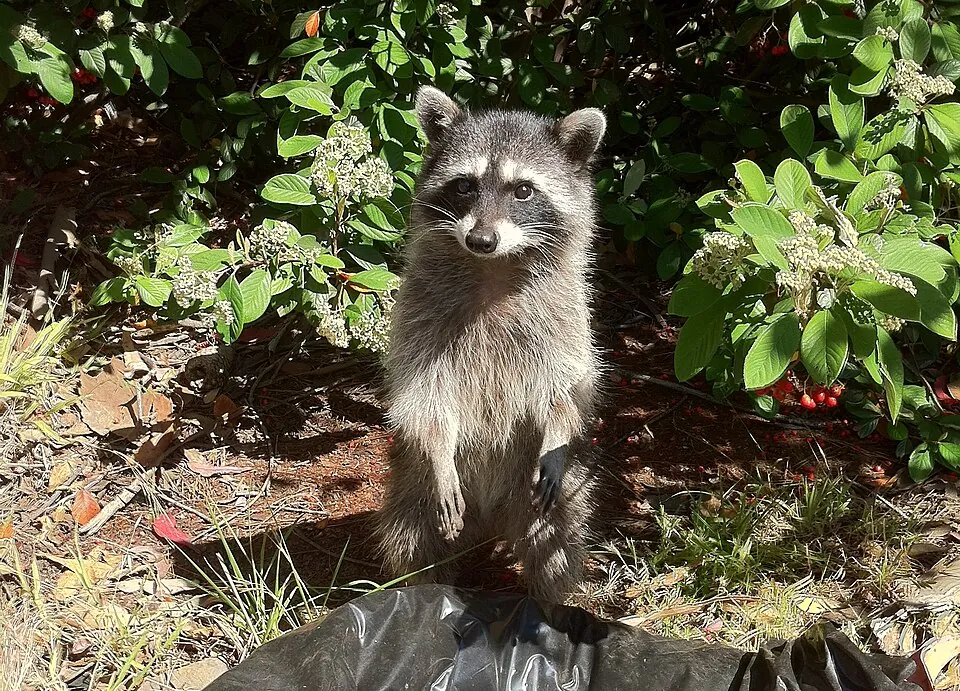
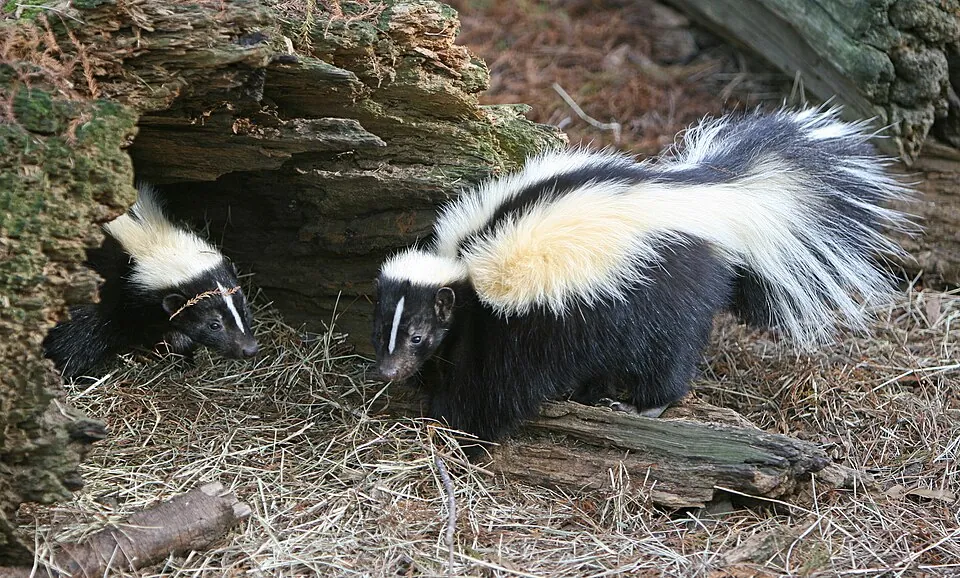
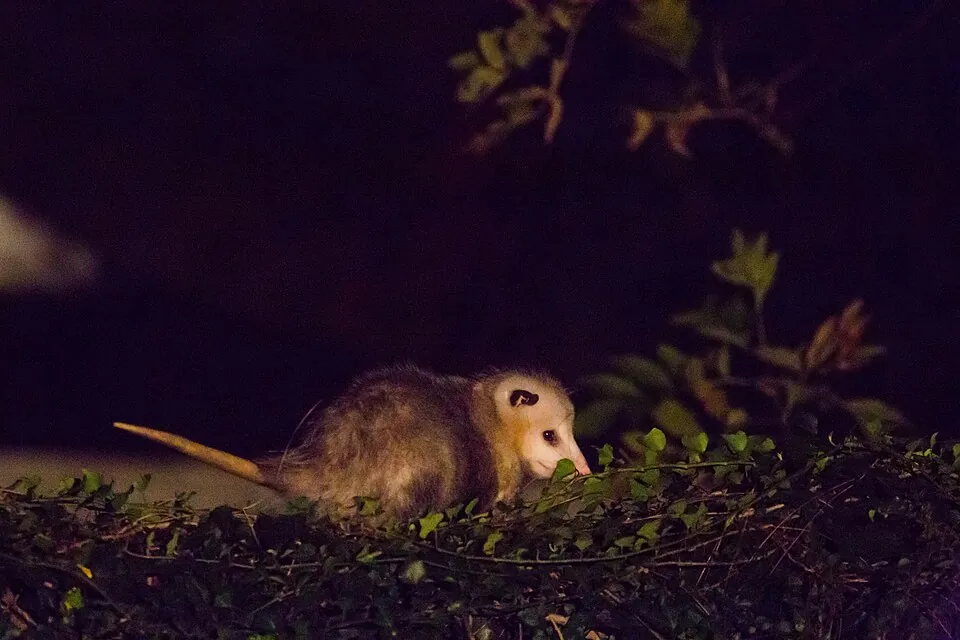
- Use a distant view or camera, not scat handling. Raccoons have a facial mask and ringed tail; skunks have contrasting black-and-white patterns; Virginia opossums have a pointed face and long bare tail.
- Distinguish visits from occupancy
- Missing pet food or disturbed turf shows feeding, while repeated entries under a deck or into an attic suggest shelter use.
Look more closely
Compare the labeled examples and their limits. Images are independently enlarged, not shown at a common scale.
Identification limits & photo credit
Representative striped-skunk pattern; striped-skunk colour patterns vary and spotted skunks differ. A daytime sighting or a photograph cannot establish illness.
Striped skunks beside a log. Photo: Tom Friedel / BirdPhotos.com. CC BY 3.0. Original source · CC BY 3.0 & details
Identification limits & photo credit
Shows the pale face and largely bare tail, with much of the frame in darkness. One species only. The image cannot establish health, behaviour or that an animal caused nearby damage.
Virginia opossum photographed at night. Photo: Melissa McMasters from Memphis, TN, United States. CC BY 2.0. Original source · CC BY 2.0 & details
Sources for this section
University of California Statewide IPM Program · UC Statewide IPM Program · UC Statewide IPM Program
Differences that change the decision
A similar-looking organism can need a different response. Compare the evidence and what it changes.
Compare every column. On a narrow screen, scroll the table sideways.
| Type | What to check | What changes |
|---|---|---|
| Raccoons | Skilled climbers and omnivores; communal latrines can occur. | Secure bins and investigate den access. Treat suspected latrines as a specialist cleanup issue. |
| Skunks | Often forage near the ground and can dig small pits or peel turf. | Keep pets away; cornering increases the risk of spraying or bites. |
| Virginia opossums | Nocturnal climbers with a bare prehensile tail; may use pet doors or under-deck shelter. | Remove overnight feed and close access once occupancy is safely resolved. Australian possums require different local guidance. |
Sources for this section
University of California Statewide IPM Program · UC Statewide IPM Program · UC Statewide IPM Program
What else could it be?
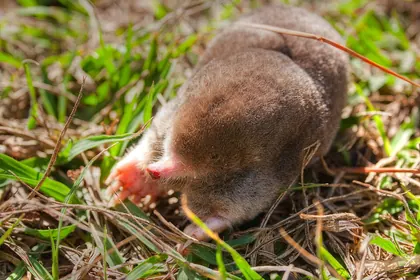
Burrowing mammals
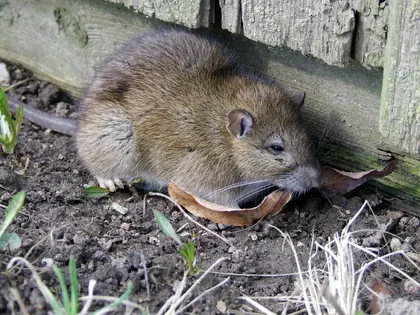
Plant loss with tunnels may be a groundhog, vole or gopher rather than night-time scavenging.
Compare burrowing wildlifeSources for this section
University of California Statewide IPM Program · University of California Statewide IPM Program
Inspect the right places
Check attractants
Inspect unsecured bins, birdseed spills, pet bowls, fallen fruit and accessible compost.
Stay out of den and latrine areas
Keep children and pets clear. Do not enter confined contaminated spaces or reach under a deck to confirm an occupant.
Sources for this section
University of California Statewide IPM Program · Centers for Disease Control and Prevention
Choose a proportionate response
For pesticides, the local product label determines the allowed pest, site, precautions and timing. Check safety and regional guidance.
Remove repeated rewards
Bring pet food indoors at night and secure refuse and access to food stores.
Arrange humane, lawful exclusion
A qualified operator should check dependent young and repair entry after safe removal; removing an animal without repairs may invite another.
Separate raccoon cleanup
Roundworm eggs can persist and most chemicals do not kill them. Contact animal control or a qualified cleanup service for a site-specific latrine plan; do not reuse a mouse-dropping checklist.
Avoid these mistakes
- Do not feed, corner or handle these animals.
- Do not put rodent poison, mothballs or improvised repellents under a building.
- Do not assume a normal-looking animal is disease-free or a daytime sighting alone proves rabies.
Sources for this section
UC Statewide IPM Program · UC Statewide IPM Program · Centers for Disease Control and Prevention
Check whether it is working
Suggested practice: record repeated visits and entries after attractants are removed; review exclusion timing with a local specialist.
No fresh entry or den use and secure food storage are useful indicators; passing wildlife need not disappear.
Get help when…
- Bite, scratch or possible saliva exposure: prompt medical or public-health advice; pet exposure needs a veterinarian.
- Raccoon latrine, trapped young or occupied building: qualified local assistance.
Sources for this section
Prevent a return
- Fit secure bin lids and protect pet doors.
- Check beneath decks before repairing screens.
- Keep sandboxes covered and clean food spills.
Sources for this section
University of California Statewide IPM Program · Centers for Disease Control and Prevention
Common questions
Can I disinfect a raccoon latrine with the mouse-cleanup method?
No. Raccoon roundworm eggs need a different cleanup assessment; most disinfectants do not kill them.
Does trapping solve the problem permanently?
Food and shelter remain attractive unless access is corrected, and relocation rules differ locally.
Sources for this section
UC Statewide IPM Program · Centers for Disease Control and Prevention
Sources & scope
References retain their geography and dates. A source-check date is not a claim of independent specialist review.
- Raccoons
University of California Statewide IPM Program. California, United States; local wildlife law and species vary; source date 2014-07; source check, not expert review Checked 2026-10-15.
- Skunks
UC Statewide IPM Program. California, US; source check, not expert review Checked 2026-10-15.
- Opossum
UC Statewide IPM Program. California, US; Virginia opossum, not Australian possums; source date 2015-10; source check, not expert review Checked 2026-10-15.
- Preventing Raccoon Roundworm
Centers for Disease Control and Prevention. United States; source date 2024-11-05; source check, not expert review Checked 2026-10-15.
- Rats
University of California Statewide IPM Program. California, United States; local wildlife law and species vary; source date 2025-06; source check, not expert review Checked 2026-10-15.
- Pocket Gophers
University of California Statewide IPM Program. California, United States; local wildlife law and species vary; source date 2025-06; source check, not expert review Checked 2026-10-15.
Individual medical or veterinary diagnosis, structural assessment, uncertain species identification and local treatment permissions require the appropriate professional. About our editorial process.
Keep investigating
Rats
Look above and below ground, then combine secure food storage, durable entry repairs and rat-sized trapping.
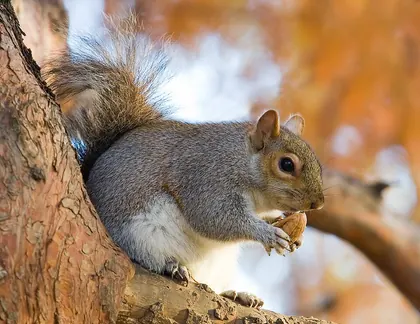
Squirrels
Observe whether the animal uses trees, roof openings or ground burrows.
Burrowing Wildlife
Match the animal to fresh signs before choosing control.