Change attraction and access
Where safe, turn off unnecessary lights, shield or move lighting away from frequently opened doors and keep screens repaired. Fans near a usable porch can reduce congregation of weak-flying midges.
Recognize the signs
- Wings and tails
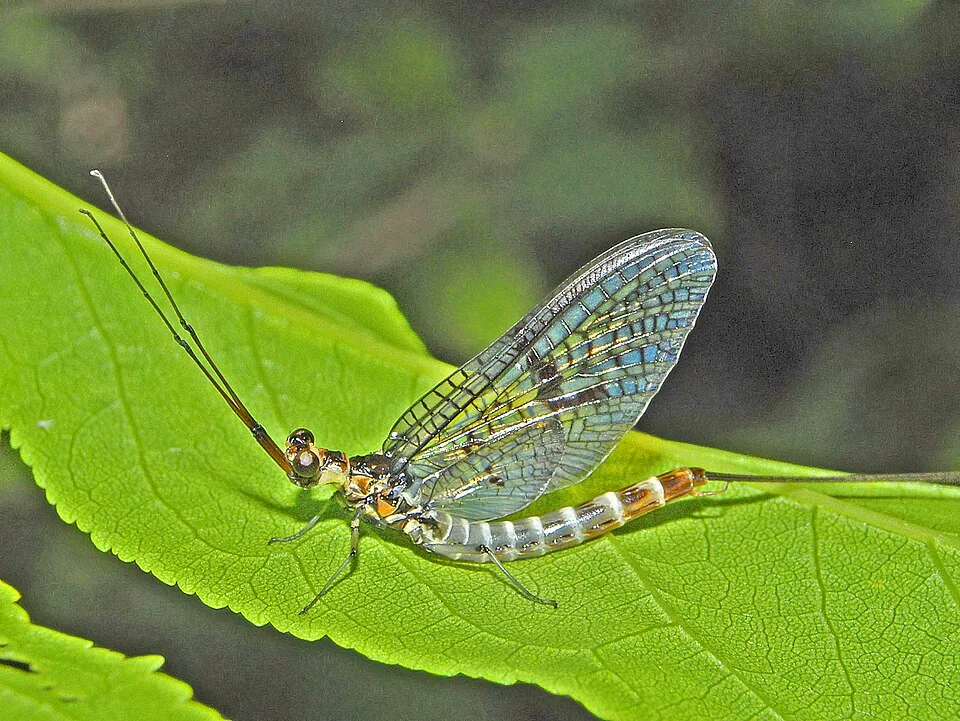
- Photograph the resting insect from the side and above. Upright triangular wings and long tail filaments suggest a mayfly; tented mothlike wings suggest a caddisfly; flat folded wings and two tails can suggest a stonefly.
- Source context
- Adults arriving at lights near water may be an aquatic emergence. Finding shed nymph skins on a tree trunk with robust flying adults and loud calling instead points toward cicadas.
- Life stages
- Mayfly and stonefly young develop in water; caddisflies and non-biting midges also have aquatic immature stages. Cicada nymphs feed underground before emerging and molting into winged adults.
Look more closely
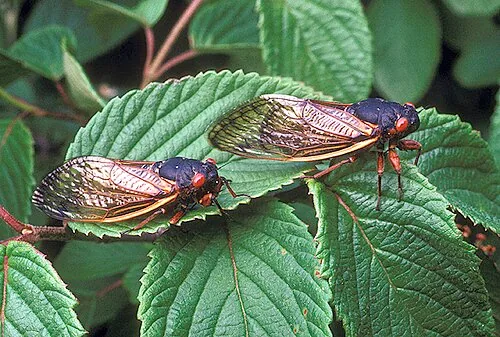
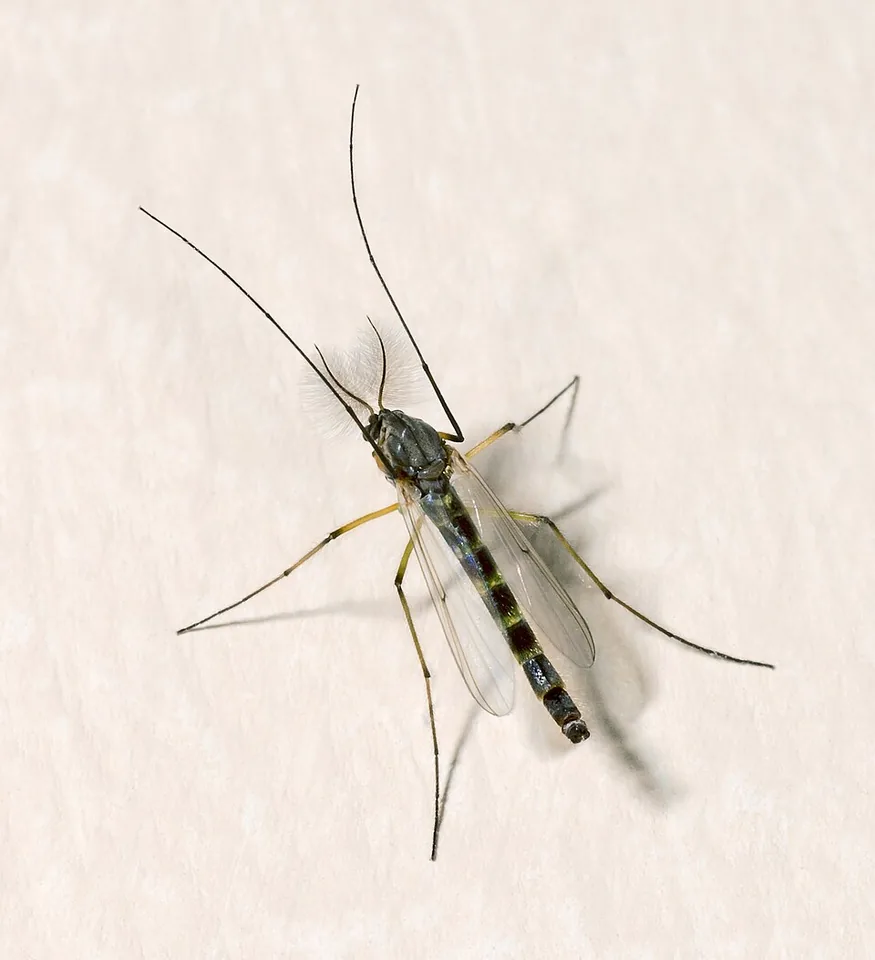
Compare the labeled examples and their limits. Images are independently enlarged, not shown at a common scale.
Identification limits & photo credit
One eastern North American periodical cicada species. Local brood timing, annual cicadas and other species differ; the image does not predict a local emergence year.
Periodical cicadas. Photo: ARS Information Staff / USDA Agricultural Research Service. Public domain. Use does not imply USDA ARS endorsement. Original source · Public domain & details
Identification limits & photo credit
A male with feathery antennae. Other midge species and females differ. This example helps distinguish a seasonal midge from mosquitoes, but no single image establishes the identity of every small swarming fly.
Male nonbiting midge. Photo: Didier Descouens. CC BY-SA 4.0. Original source · CC BY-SA 4.0 & details
Differences that change the decision
A similar-looking organism can need a different response. Compare the evidence and what it changes.
Compare every column. On a narrow screen, scroll the table sideways.
| Type | What to check | What changes |
|---|---|---|
| Mayflies | Slender adults typically have two or three long tail filaments and delicate triangular wings held upright. | They are harmless seasonal visitors. Keep doors screened and remove accumulations from paths without treating the water that supports their young. |
| Caddisflies | Often drab, mothlike adults with long antennae and wings held roof-like over the body. | A gathering near water and lights is not proof of clothes moths. Look for the actual source before inspecting every fabric item for damage. |
| Stoneflies | Adults generally fold their wings flat and retain two tail-like cerci; immature stages live in freshwater. | They are low-conflict visitors. A clear specimen can separate them from similar aquatic insects; no routine household treatment is needed. |
| Non-biting midges | Chironomid adults can resemble mosquitoes and form dense swarms; they lack the female mosquito's long piercing proboscis. | Reduce light attraction and entry. Confirm the group because the informal word midge also includes biting insects with different biology. |
| Annual or dog-day cicadas | Large adults, often green or brown, appear in seasonal numbers; calling males and empty skins are conspicuous. | Ordinary activity generally needs no control. Annual appearance does not mean every individual completes development in one year. |
| Periodical cicadas | Magicicada broods can emerge synchronously in large numbers in parts of eastern North America; many adults have red eyes and orange wing veins. | Consult current local brood information. Protect vulnerable newly planted trees from egg-laying where a local emergence is expected, instead of spraying the entire landscape. |
What else could it be?
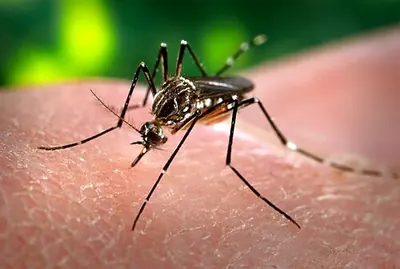
Mosquitoes
An identified female mosquito has piercing mouthparts; a swarm or an itch alone does not separate it from non-biting flies.
Compare mosquitoesPantry or clothes moths
Repeated adults near food or fabrics need a search for larvae, webbing or damage there. A caddisfly at a light has a different origin.
Winged ants or termites
Paired wings with different proportions and body forms require a closer specimen. A sudden flight is not automatically an aquatic emergence.
Other causes of twig dieback
Cicada egg-laying makes slits in young twigs. Wilt without that evidence can have other causes and should not be diagnosed from the season alone.
Sources for this section
University of Minnesota Extension · University of Maryland Extension
Inspect the right places
Record the setting
Note distance to water, weather, time, the light involved and whether insects are arriving from outside. Check screens and take clear photographs of a few individuals rather than assuming all insects in the swarm are identical.
For cicada concerns
Look for empty emergence skins and egg-laying slits on affected twigs. Identify the tree and distinguish a mature established tree from a small newly planted one before deciding it needs protection.
For large aquatic swarms
Map the door or light where accumulation occurs. Do not enter water or treat a public shoreline to investigate household nuisance.
Sources for this section
North Carolina Cooperative Extension · North Carolina Cooperative Extension · University of Maryland Extension
Choose a proportionate response
For pesticides, the local product label determines the allowed pest, site, precautions and timing. Check safety and regional guidance.
Change attraction and access
Where safe, turn off unnecessary lights, shield or move lighting away from frequently opened doors and keep screens repaired. Fans near a usable porch can reduce congregation of weak-flying midges.
Clean the affected surfaces
Sweep or vacuum accumulated insects and keep steps and paths clear. Very large public-road or waterside accumulations belong with the responsible property or municipal service.
Protect a vulnerable tree when justified
Before local periodical-cicada egg laying, ask extension about suitable insect mesh for small trees. Secure it without constricting the trunk, inspect it during use and remove it after the local risk period. Broad bird netting can have openings too large to exclude cicadas.
Preserve the surrounding ecosystem
Aquatic insects feed fish, birds and other wildlife. Control is generally unnecessary for the emergence itself; avoid adding pesticides or improvised chemicals to water.
Avoid these mistakes
- Do not diagnose mosquitoes from a cloud of small flies at a light.
- Do not use an old brood-year article as a forecast for the current location and year.
- Do not spray established trees simply because cicada shells are present; mature trees usually tolerate ordinary activity.
- Do not expect a residual wall spray to stop repeated emergence from a lake or stream.
Check whether it is working
Editorial suggestion: record the duration and location of the local flight and whether light or screen changes reduce entry. Check any protective tree mesh regularly; emergence timing varies by species, weather and location.
People can use entrances and paths with manageable nuisance, and a protected young tree avoids extensive fresh egg-laying injury. A natural outdoor emergence need not disappear for household measures to succeed.
Get help when…
- Ask extension to identify an uncertain biting-versus-non-biting fly before treatment.
- Have significant young-tree damage or unexplained dieback assessed by a plant diagnostic service or arborist.
- Refer major public access or roadway nuisance to the responsible authority rather than attempting water treatment.
Sources for this section
North Carolina Cooperative Extension · North Carolina Cooperative Extension · University of Maryland Extension
Prevent a return
- Plan lighting and door use around locally recurring emergences.
- Maintain screens before the usual flight period.
- For a scheduled local periodical-cicada brood, consider timing new tree planting and any protective mesh with local extension guidance.
Sources for this section
North Carolina Cooperative Extension · North Carolina Cooperative Extension · University of Maryland Extension
Common questions
Do cicadas eat the leaves off trees?
They are not leaf-chewing insects. The notable injury during dense periodical emergences is female egg laying in twigs, especially on vulnerable young trees.
Are blind mosquitoes actually mosquitoes?
That nickname is often used for non-biting aquatic midges. Confirm the insect's anatomy; common names alone do not establish whether it can bite.
Sources for this section
North Carolina Cooperative Extension · University of Maryland Extension · University of Minnesota Extension
Sources & scope
References retain their geography and dates. A source-check date is not a claim of independent specialist review.
- Mayflies
University of Minnesota Extension. Minnesota identification and harmless visitor status. Checked 2026-10-15.
- Caddisflies
University of Minnesota Extension. Minnesota adult morphology and aquatic context. Checked 2026-10-15.
- Indicator Insects: Stoneflies and Mayflies
Penn State Extension. Pennsylvania; updated April 2025; aquatic stages and harmless adult visitors. Checked 2026-10-15.
- Non-Biting Midge Flies
North Carolina Cooperative Extension. North Carolina aquatic emergence and lighting management; local seasonal dates are not generalized. Checked 2026-10-15.
- Midge Madness
North Carolina Cooperative Extension. North Carolina household nuisance, lighting and fan measures. Checked 2026-10-15.
- Cicadas in Maryland
University of Maryland Extension. Updated September 2026; eastern US biology and young-tree protection. Brood schedules must be checked for the actual location. Checked 2026-10-15.
- Cicadas
University of Minnesota Extension. Minnesota annual cicadas and their low management need; periodical broods are not present everywhere. Checked 2026-10-15.
Individual medical or veterinary diagnosis, structural assessment, uncertain species identification and local treatment permissions require the appropriate professional. About our editorial process.
Keep investigating
Mosquitoes
Start with water-holding containers and protection from bites.
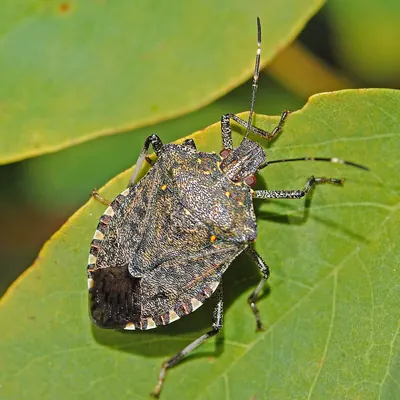
Overwintering insects
Seasonal clusters at a sunny wall or window often involve adults seeking shelter.