
For an exposed swarm
Contact a local beekeeper association or experienced swarm collector with the photograph, height and access details. Availability and legal requirements vary; arrange the service rather than moving the cluster yourself.
Sources for this section
University of California IPM · University of Minnesota Extension · UK NHS · UK NHS
Recognize the signs
- Look at behavior as well as hair
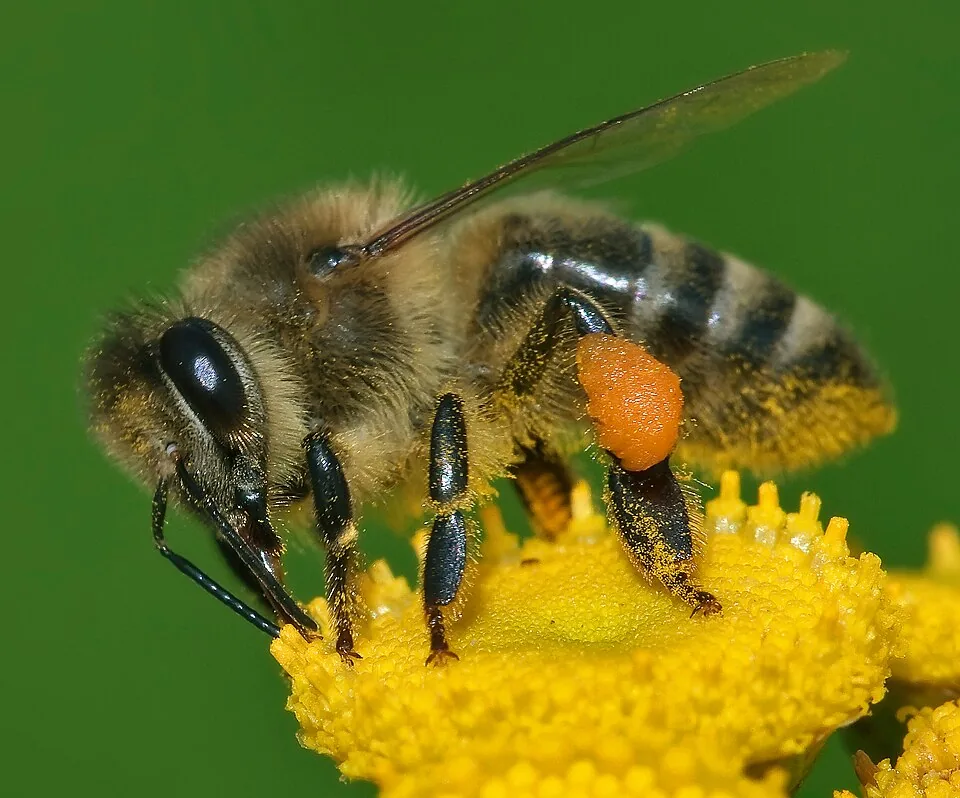
- Many bees carry pollen on legs or abdominal hairs. Color and fuzziness vary, so observe flowers, nest entrances and any cluster from a distance rather than relying on stripes.
- Brood and colony
- Bee larvae develop in provisioned cells and later pupate. Honey bees maintain a colony and comb; bumble bees have a different, usually annual temperate colony cycle. Each solitary female provisions her own offspring.
Look more closely
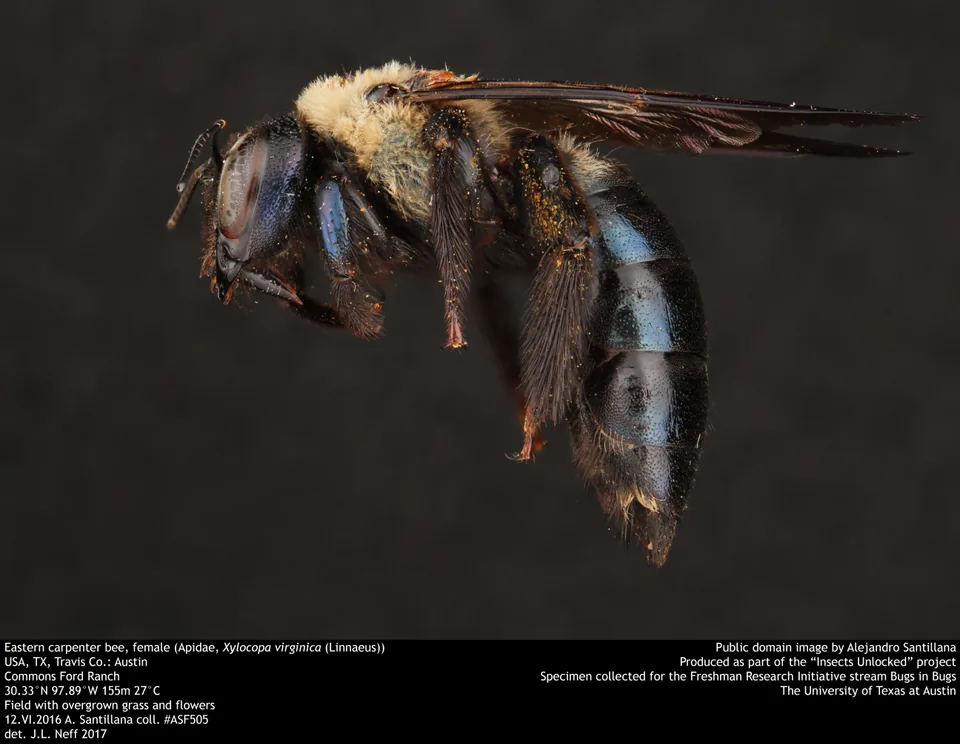
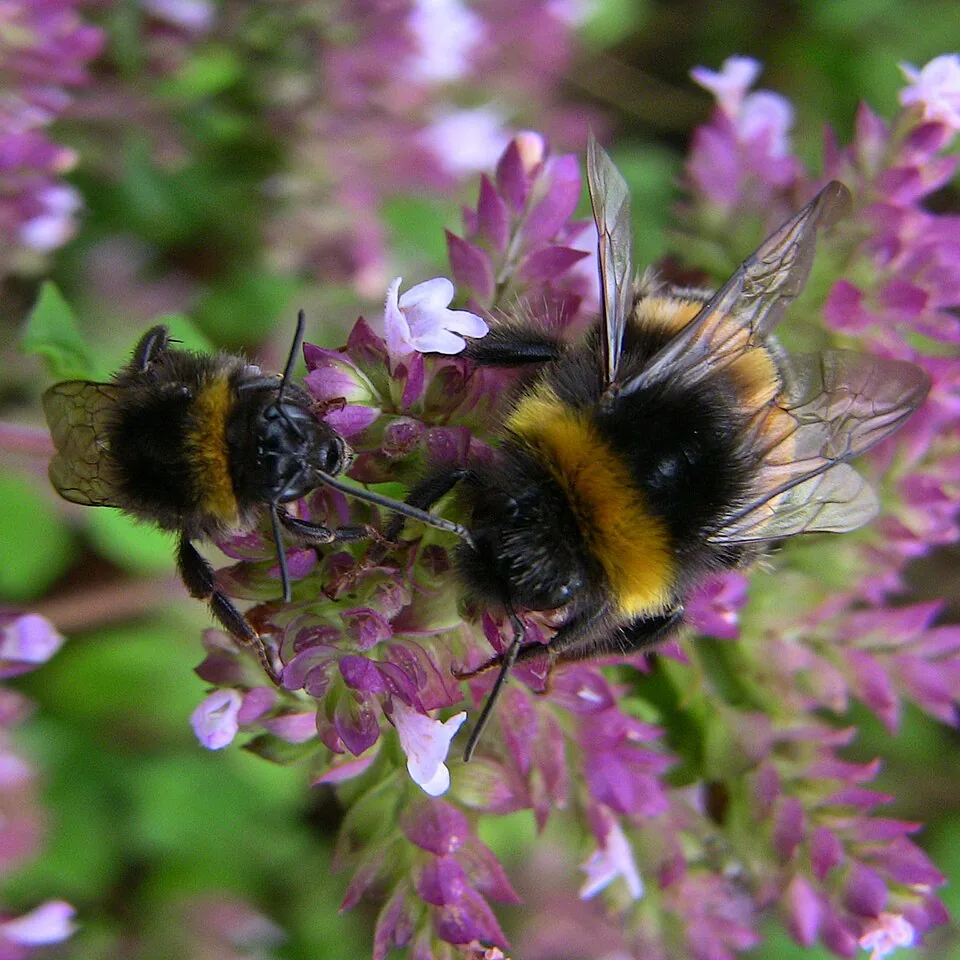
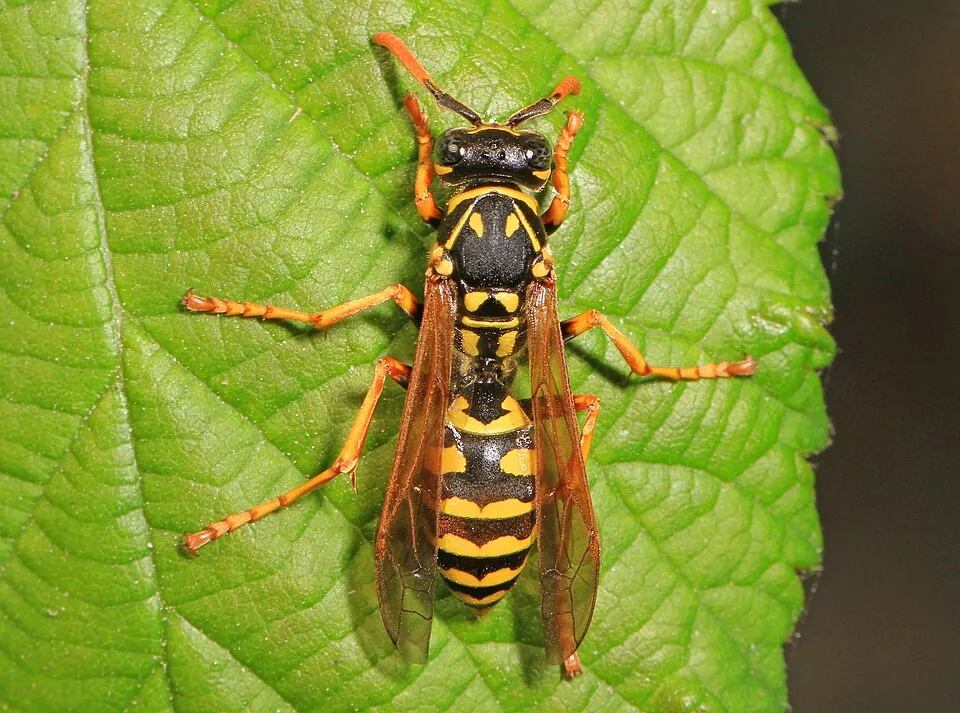
Compare the labeled examples and their limits. Images are independently enlarged, not shown at a common scale.
Identification limits & photo credit
A female example with a relatively shiny abdomen. Other carpenter bees vary, and the photograph does not show a nest entrance or prove damage to a particular timber.
Female eastern carpenter bee, side view. Photo: Alejandro Santillana / Insects Unlocked, University of Texas at Austin. CC0. Original source · CC0 & details
Identification limits & photo credit
Source labels a small female worker at left and larger male at right. This European bumblebee example illustrates a hairy abdomen; it is not a key to North American bumblebees or every bee species.
Two buff-tailed bumblebees on flowers. Photo: linsepatron. CC BY 2.0. Original source · CC BY 2.0 & details
Identification limits & photo credit
One paper-wasp species. Nest type and location matter, and other paper wasps vary in color. Do not approach or disturb a nest to match this photograph.
European paper wasp. Photo: Judy Gallagher. CC BY 2.0. Original source · CC BY 2.0 & details
Identification limits & photo credit
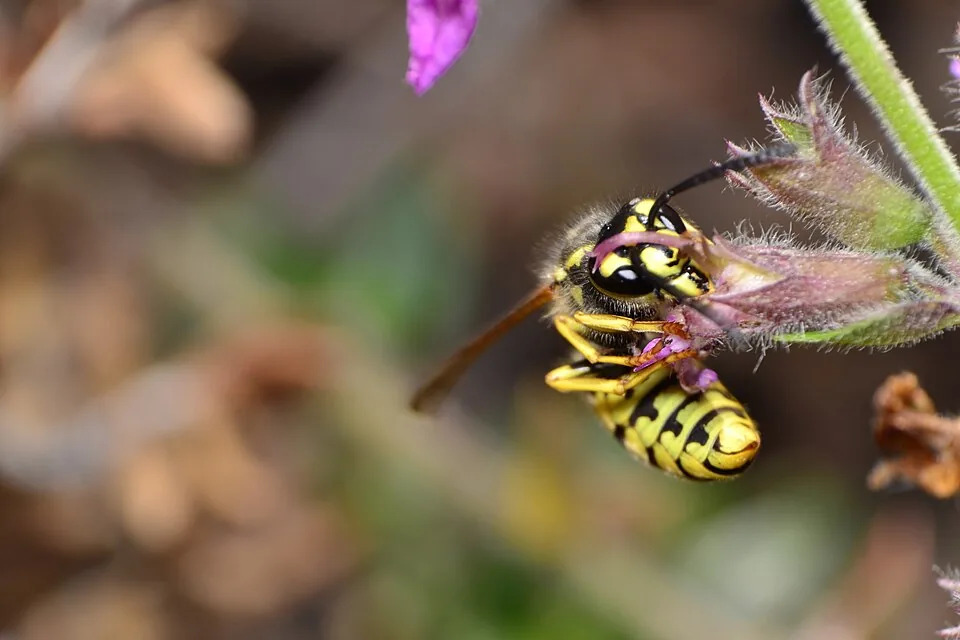
One yellowjacket species. Markings vary and photographs do not reliably identify every yellowjacket; follow the nest and flight-path evidence from a safe distance.
German yellowjacket on a flower. Photo: Manuel Hervas. CC BY-SA 4.0. Original source · CC BY-SA 4.0 & details
Sources for this section
Differences that change the decision
A similar-looking organism can need a different response. Compare the evidence and what it changes.
Compare every column. On a narrow screen, scroll the table sideways.
| Type | What to check | What changes |
|---|---|---|
| Honey-bee swarm | A dense exposed cluster may be a travelling colony temporarily resting while scouts seek a new home. | Keep the area clear and contact a beekeeper or local swarm service. Do not shake the cluster or assume it is safe to touch. |
| Established honey-bee colony | Regular traffic into a cavity over time may indicate comb and brood inside. | Ask an experienced removal service about inspection, bees, comb and honey removal, repairs and follow-up. Killing visible bees alone can leave material in the structure. |
| Bumble bees | Often robust and hairy, nesting in a cavity such as an old underground animal nest. | A remote colony can usually be avoided. A nest beside unavoidable activity needs specialist advice; do not treat the entrance as a harmless solitary burrow without checking. |
| Ground-nesting solitary bees | Many separate small entrances can occur in suitable bare soil, creating a busy-looking aggregation. | Allow the nesting area where possible. Many neighbors do not necessarily mean a shared colony defending one nest. |
| Mason and leafcutter bees | Females use cavities and may seal brood cells with mud or leaf pieces; leafcutter bees can make neat leaf-edge cuts. | Protect occupied stems or holes rather than clearing them immediately. Small leaf cuts rarely justify control, and these bees are useful pollinators. |
| Sweat bees and other small solitary bees | Some are small, metallic or easily mistaken for flies; local nesting habits vary. | Observe and identify before intervention. A bee landing on a person or flower is not evidence of a household infestation. |
Sources for this section
University of California IPM · Penn State Extension · University of Minnesota Extension · University of Minnesota Extension Bee Atlas
What else could it be?
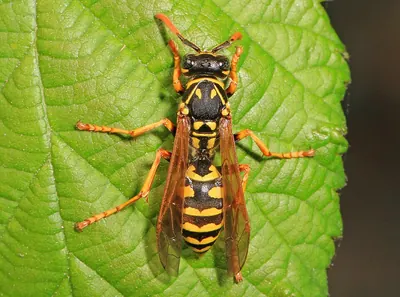
Yellowjackets
A concentrated stream through a shared ground opening may be a social wasp colony. Ground bee is an unreliable common name.
Compare waspsCarpenter bees
Large bees using fresh excavated wood tunnels need a wood-specific assessment. Cavity-using mason bees do not automatically imply the same damage.
Hoverflies
Bee-like color can be mimicry; a clear view of one wing pair helps identify a fly. Do not infer a sting from yellow bands.
Sources for this section
Inspect the right places
Record the situation safely
Photograph from a distance and note whether there is a temporary cluster, one shared entrance or multiple independent holes. Note how long activity has been present and any nearby maintenance work.
Check the practical conflict
Can the route or work be postponed while the nest is active? Keep children and pets away, and factor in known sting allergy. Avoid opening walls or lifting a nest cover to obtain proof.
Sources for this section
Choose a proportionate response
For pesticides, the local product label determines the allowed pest, site, precautions and timing. Check safety and regional guidance.
For an exposed swarm
Contact a local beekeeper association or experienced swarm collector with the photograph, height and access details. Availability and legal requirements vary; arrange the service rather than moving the cluster yourself.
For a cavity colony
Obtain a plan that covers safe access, the colony and residual comb, then repair the entry after removal. Coordinate with the property owner and a building professional if opening the structure is necessary.
For solitary nesting
Leave a suitable area undisturbed if possible. Avoid applying broad insecticide to active flowers, bare-soil nests or occupied bee shelters. If a nest blocks essential work, ask a local pollinator specialist about timing.
Remove a retained stinger
Once away from the bees, promptly brush or scrape out a visible retained stinger without squeezing its venom sac, then wash the site. Use a wrapped cold pack for swelling and obtain suitable symptom advice from a pharmacist or clinician. Serious symptoms take priority over local first aid.
After a sting
Move away from the insects. Breathing difficulty, throat or tongue swelling, faintness or collapse requires emergency help and prescribed emergency medication as directed. Obtain clinical advice for other concerning reactions.
Sources for this section
University of California IPM · University of Minnesota Extension · UK NHS · UK NHS
Avoid these mistakes
- Do not seal an occupied honey-bee entrance; trapped bees may seek routes into the building.
- Do not spray a flowering plant to prevent ordinary bee visits.
- Do not assume a beekeeper can remove any nest, at any height, for free; describe the real access and structural work.
- Do not transport an occupied nest without expertise and any required local permissions.
Sources for this section
Check whether it is working
Editorial suggestion: log the date and type of activity from a safe distance. Use the removal provider's follow-up plan for established colonies; observe solitary nest use without repeatedly disturbing entrances.
People can use the necessary area safely, with the colony protected in place or appropriately removed and the building repaired. Absence of a few visible foragers is not proof that a cavity is empty.
Get help when…
- Use emergency medical services for a severe reaction; do not wait for bee identification.
- Persistent cavity traffic, honey leakage or bees entering rooms needs an experienced colony-removal service.
- Uncertain ground activity near play or work areas should be identified before anyone mows or excavates.
Sources for this section
Prevent a return
- Maintain screens and close unoccupied building gaps during ordinary repairs.
- Provide pollinator habitat away from paths that require frequent disturbance.
- Keep existing occupied stems and suitable nesting soil where safe; consult local guidance before seasonal cleanup.
Sources for this section
Common questions
Is a swarm the same as a nest in my wall?
No. A cluster may be temporarily resting; an established cavity colony contains comb and needs a more involved removal and repair plan.
Are holes in leaves evidence that bees should be killed?
Neat leaf-edge cuts can be leafcutter-bee activity. These pollinators use pieces for nest cells, and modest cosmetic cutting is usually compatible with a healthy plant.
Sources for this section
University of California IPM · University of Minnesota Extension Bee Atlas
Sources & scope
References retain their geography and dates. A source-check date is not a claim of independent specialist review.
- Removing Honey Bee Swarms and Established Hives
University of California IPM. California honey-bee removal distinctions; services and laws differ locally. Checked 2026-10-15.
- Common Social Bees and Wasps of Pennsylvania
Penn State Extension. Temperate North American social bee and wasp comparisons. Checked 2026-10-15.
- Nests for Pollinators
University of Minnesota Extension. Minnesota; ground, cavity and stem nesting and habitat protection. Checked 2026-10-15.
- Megachilidae: Leafcutting, Mason and Resin Bees
University of Minnesota Extension Bee Atlas. Minnesota bee identification and cell materials. Checked 2026-10-15.
- Anaphylaxis
UK NHS. Emergency symptom recognition; use the emergency number applicable to the reader's location. Checked 2026-10-15.
- Insect Bites and Stings
UK NHS. Basic first aid and clinical escalation; local healthcare and emergency arrangements apply elsewhere. Checked 2026-10-15.
Individual medical or veterinary diagnosis, structural assessment, uncertain species identification and local treatment permissions require the appropriate professional. About our editorial process.
Keep investigating
Wasps
A foraging wasp, a solitary mud nest and a busy social colony need different responses.
Seasonal flyers
Many insects gathering at lights developed in nearby water or soil and are not breeding inside the house.
Spiders
Most household and garden spiders are predators that can be left alone or moved out of the immediate activity area.