
Create space first
Mark or avoid the affected area and postpone disturbance. If wasps become defensive, move away promptly to shelter rather than staying to swat them.
Sources for this section
Recognize the signs
- Nest activity
- Repeated traffic through one opening or a visible paper nest supports a colony nearby. A single insect visiting flowers or food does not locate a nest.
- Development
- Eggs, grub-like larvae and pupae develop in brood cells. Temperate social wasp colonies usually build seasonally; solitary females provision their own nests. Local climate and species affect timing.
Look more closely
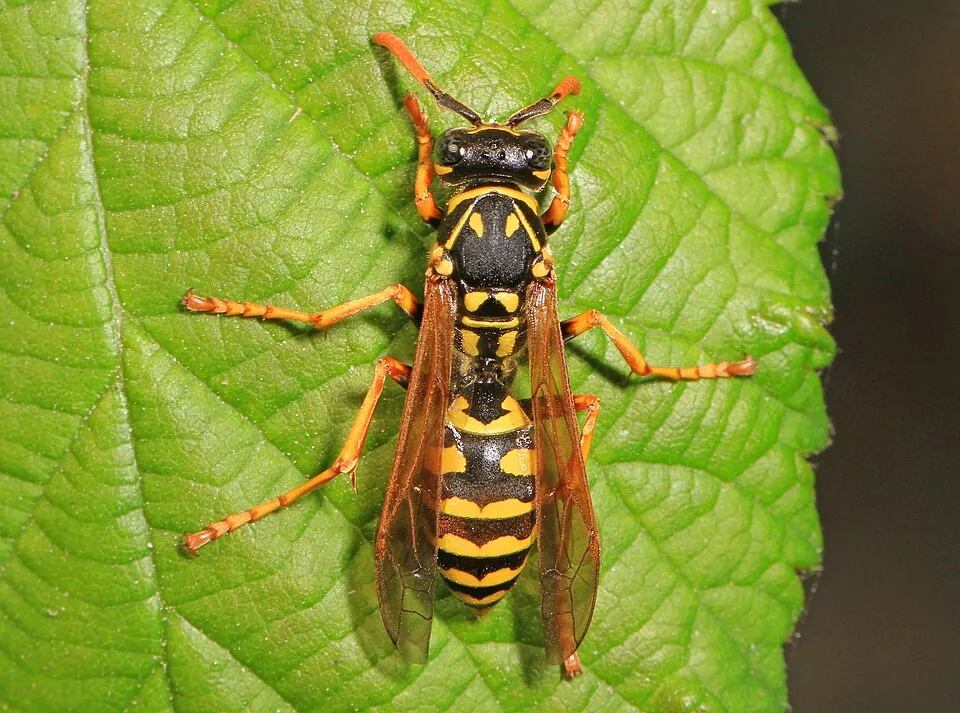
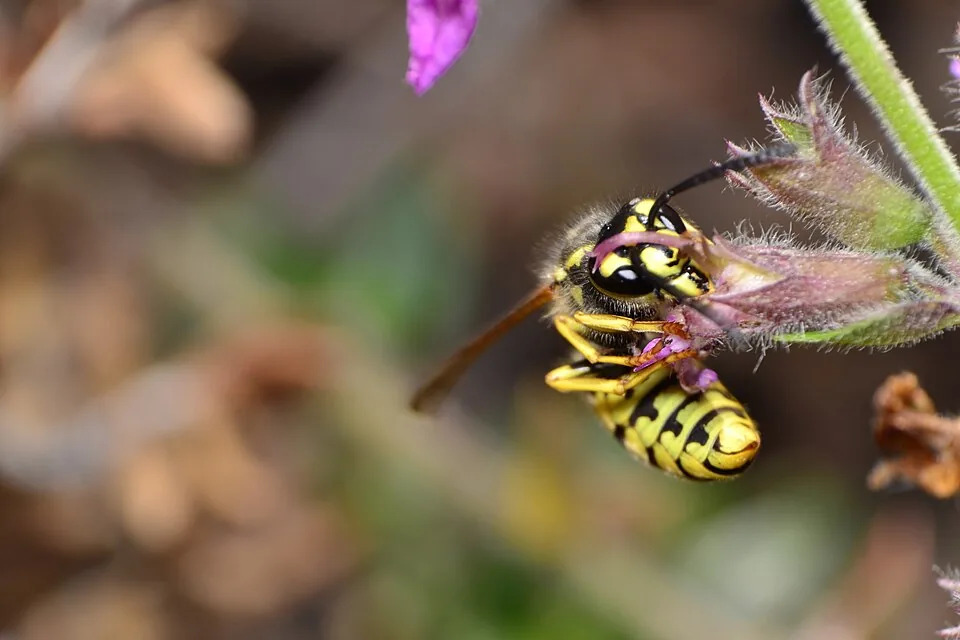
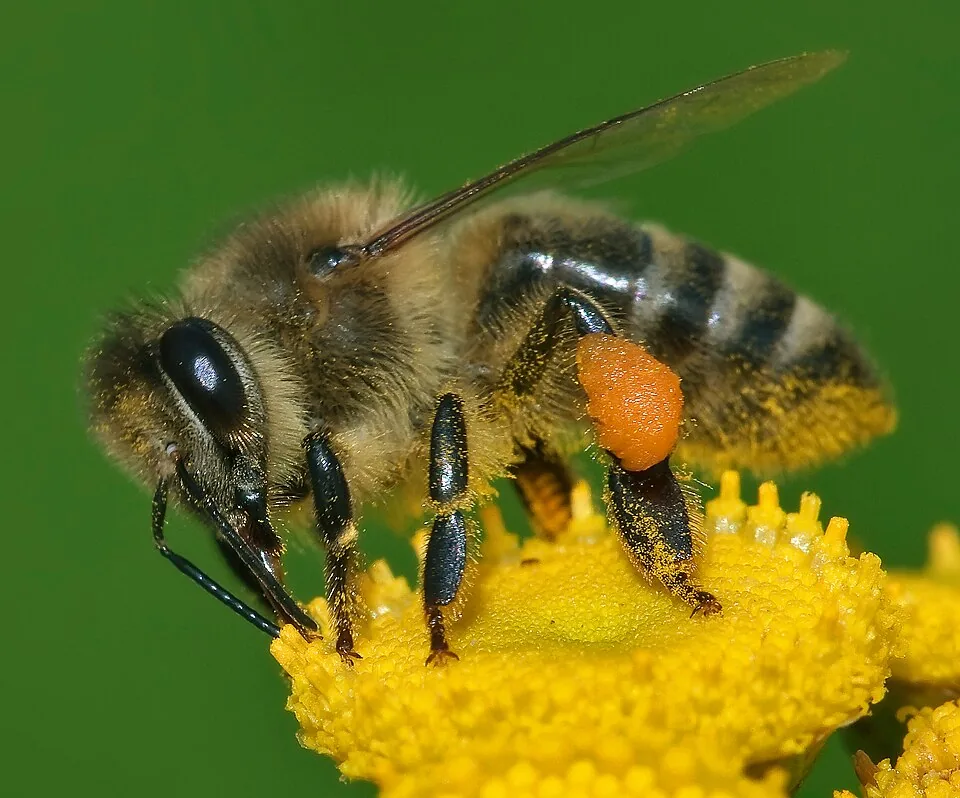
Compare the labeled examples and their limits. Images are independently enlarged, not shown at a common scale.
Identification limits & photo credit
One yellowjacket species. Markings vary and photographs do not reliably identify every yellowjacket; follow the nest and flight-path evidence from a safe distance.
German yellowjacket on a flower. Photo: Manuel Hervas. CC BY-SA 4.0. Original source · CC BY-SA 4.0 & details
Identification limits & photo credit
One honey bee worker. It does not represent bumblebees or solitary bees, and it cannot establish whether an observed cluster is a temporary swarm or an established colony.
Western honey bee on a flower. Photo: Andreas Trepte. CC BY-SA 2.5. Original source · CC BY-SA 2.5 & details
Sources for this section
Differences that change the decision
A similar-looking organism can need a different response. Compare the evidence and what it changes.
Compare every column. On a narrow screen, scroll the table sideways.
| Type | What to check | What changes |
|---|---|---|
| Paper wasps | Often slender, with dangling legs in flight and an exposed umbrella of open cells. European paper wasps can be black and yellow like yellowjackets. | Assess the open nest's position. An out-of-the-way colony may be left; one beside a frequently used door needs a risk-based plan. |
| Yellowjackets | Compact social wasps may nest underground or in building voids; some visit food and drink. | Keep away from a busy ground opening and postpone mowing nearby. A wall-void nest needs professional planning before entry repairs. |
| Bald-faced hornets | Black-and-white social wasps commonly build an enclosed paper nest above ground. | Leave a remote nest undisturbed; do not hit it, prune into it or attempt removal from a ladder. |
| European hornets | Large social wasps with reddish-brown and yellow areas often use cavities and may forage at night. | Night activity at a light is possible and does not identify a different invasive hornet. Confirm the species and cavity before intervention. |
| Mud daubers and potter wasps | Solitary females make mud tubes, pots or partitions and provision larvae with prey. | These are usually low-conflict beneficial visitors. A mud structure is not evidence of an aggressive social colony. |
| Velvet ants | Hairy, often brightly colored wingless females are wasps, not ants; males are winged. Their larvae develop on other insects' immature stages. | Do not handle or step on one barefoot: a female can give a painful sting. A lone wandering individual does not justify ant-bait treatment. |
| Cicada killers and other solitary ground wasps | Several independent burrows can occur together, with females carrying prey. | Distinguish separate nests from a social colony's shared entrance before deciding whether an area needs intervention. |
Sources for this section
Penn State Extension · University of Maryland Extension · University of Florida IFAS · Penn State Extension
What else could it be?
Bees
Many bees have conspicuous pollen-carrying hairs, but appearance varies. Flower visits and yellow stripes alone do not separate bees from wasps.
Compare beesHoverflies
Often imitate bee or wasp colors; a good view shows one wing pair rather than two. They do not have a sting.
Ants
An ant has characteristic waist nodes; the wingless female velvet ant can deceive a quick glance. Do not pick up an unknown insect to inspect it.
Sources for this section
Inspect the right places
Observe from outside the flight path
Use zoom or binoculars from a safe distance. Record nest material, location and whether insects share a single opening. Keep children and pets away and avoid blocking the entrance.
Decide whether there is a conflict
Consider access to doors, play areas and maintenance routes, plus allergy history. Nest size alone is not the decision: a small nest beside a handrail can present more contact risk than a distant colony.
Sources for this section
Choose a proportionate response
For pesticides, the local product label determines the allowed pest, site, precautions and timing. Check safety and regional guidance.
Create space first
Mark or avoid the affected area and postpone disturbance. If wasps become defensive, move away promptly to shelter rather than staying to swat them.
Reduce food conflict
Keep outdoor food and refuse covered, clear fallen fruit where practicable and inspect drinks before sipping. These steps reduce encounters with scavenging wasps without assuming every nearby nest must be removed.
Use a professional for difficult nests
Request identification, the nest location and a written plan for safe access, treatment if needed, follow-up and entry repair. Do not seal an active wall opening first; insects may seek another route, including indoors.
Care for a local sting
Move clear of the insects, wash the area and use a wrapped cold pack for swelling. A pharmacist can advise on symptom relief appropriate to age and health. Worsening symptoms, multiple stings or a sting near the eye, mouth or throat need prompt medical advice.
Respond to a severe reaction
Breathing difficulty, tongue or throat swelling, faintness or collapse after a sting are an emergency. Contact local emergency services and use prescribed emergency medication as directed. Do not delay care to identify the insect.
Sources for this section
Avoid these mistakes
- Do not burn, flood, strike or pour fuel into a nest.
- Do not spray a nest from a ladder or rely on darkness to make it safe.
- Do not mistake several solitary burrows for one defensive colony without observation.
- Do not assume a yellowjacket trap removes an established nest or protects every person from stings.
Sources for this section
Check whether it is working
Editorial suggestion: keep a dated, distant observation of the entrance or conflict area without provoking the colony. Following professional work, use the provider's recheck and access instructions.
The conflict is resolved when the required access can be used safely and the identified nest is inactive or professionally managed. A temporary lull in flight during cold or wet weather is not proof of elimination.
Get help when…
- Seek emergency care for severe allergic symptoms; obtain medical advice for multiple stings, a sting in the mouth or throat, or concerning symptoms.
- A hidden cavity, height, uncertain species or nest beside unavoidable activity merits qualified pest-professional assessment.
- Report a suspected locally regulated invasive hornet to the designated authority with a distant photograph; do not approach for a better specimen.
Sources for this section
Penn State Extension · Penn State Extension · UK NHS · UK NHS
Prevent a return
- Repair potential entry gaps after verifying that active occupants will not be enclosed.
- Keep outdoor waste sealed and inspect sheltered eaves from a distance during routine maintenance.
- Retain beneficial wasps where people can avoid their nesting area.
Sources for this section
Common questions
Must every nest be removed?
No. A remote social nest or solitary wasp nest may cause no practical conflict. Location, exposure and the occupants' needs determine the response.
Can I plug the hole and make them leave?
Not while a social colony is active. Blocking the visible entrance may redirect insects into occupied rooms and complicate treatment.
Sources for this section
Sources & scope
References retain their geography and dates. A source-check date is not a claim of independent specialist review.
- Common Social Bees and Wasps of Pennsylvania
Penn State Extension. Pennsylvania and temperate North American colony distinctions; not a universal seasonal calendar. Checked 2026-10-15.
- Getting Rid of Paper Wasps, Yellowjackets, and Other Stinging Insects
Penn State Extension. Updated January 2026; risk-based nest management and wall-void caution. Checked 2026-10-15.
- Predatory Wasps
University of Maryland Extension. Maryland; social versus solitary biology and beneficial role. Checked 2026-10-15.
- Velvet Ants, Mutillidae
University of Florida IFAS. Florida identification and family biology; appearance varies by species. Checked 2026-10-15.
- European Hornet
Penn State Extension. Pennsylvania; European hornet nesting and nighttime activity. Checked 2026-10-15.
- Anaphylaxis
UK NHS. Emergency symptom recognition; contact the emergency service for the reader's location. Checked 2026-10-15.
- Insect Bites and Stings
UK NHS. Basic first aid and clinical escalation; local healthcare and emergency arrangements apply elsewhere. Checked 2026-10-15.
Individual medical or veterinary diagnosis, structural assessment, uncertain species identification and local treatment permissions require the appropriate professional. About our editorial process.
Keep investigating
Spiders
Most household and garden spiders are predators that can be left alone or moved out of the immediate activity area.
Scorpions
Keep your distance from an unidentified scorpion and check likely contact points such as shoes, bedding and stored materials.