
Choose treatment after identification
For structural infestations, use a properly licensed provider. Ask why the proposed method fits the termite group and construction, what it reaches, and what it cannot reach.
Sources for this section
University of California Statewide IPM Program · US Environmental Protection Agency · University of Kentucky Extension
Recognize the signs
- Winged ant versus termite
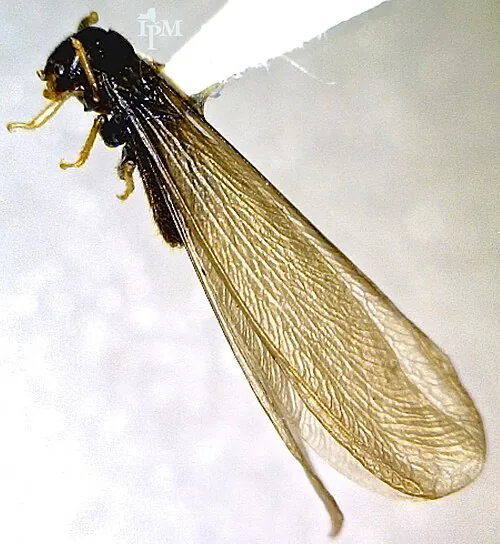
- Termite swarmers have a broad waist, straighter antennae and roughly equal-sized wings. Ants have a narrow waist, elbowed antennae and smaller hindwings. Keep a specimen where safely possible.
- Activity versus historical evidence
- Live termites confirm activity; old galleries, holes and tubes may remain. Drywood pellets can fall because of vibration, so a new pile is not by itself proof of a live colony or its extent.
- Hidden damage
- Much activity occurs inside timber, soil or inaccessible voids. Surface appearance cannot establish structural soundness. Do not probe compromised load-bearing material yourself.
Look more closely
Compare the labeled examples and their limits. Images are independently enlarged, not shown at a common scale.
Identification limits & photo credit
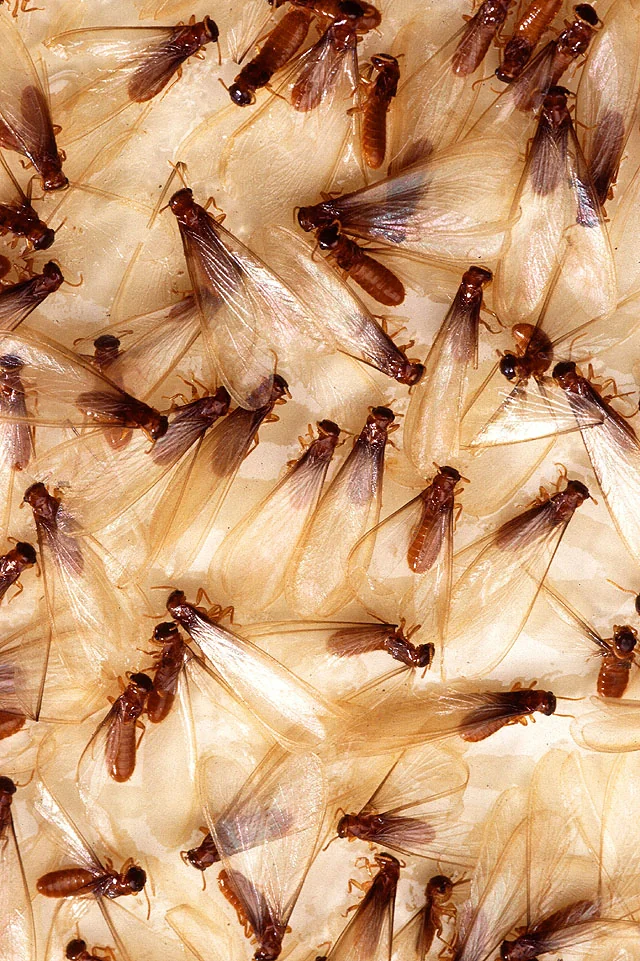
Multiple trapped swarmers with overlapping wings. This is a Formosan termite example, not a diagnostic plate for all termites; a swarmer does not establish the extent of structural infestation.
Formosan termite swarmers captured on a monitoring trap. Photo: Scott Bauer, USDA Agricultural Research Service. Public domain (U.S. government work). Use does not imply USDA ARS endorsement. Original source · Public domain (U.S. government work) & details
Differences that change the decision
A similar-looking organism can need a different response. Compare the evidence and what it changes.
Compare every column. On a narrow screen, scroll the table sideways.
| Type | What to check | What changes |
|---|---|---|
| Subterranean termites | Often associated with soil, shelter tubes and moisture; feeding can be concealed behind intact surfaces. | Inspection must consider soil-to-building routes and the whole structure. Professional bait or soil-treatment systems require an appropriate design and continuing service. |
| Drywood termites | Live within wood without requiring a soil connection; characteristic ridged pellets may be expelled through small openings. | Compare localised versus whole-structure options. A spot treatment addresses known locations and may miss concealed colonies; confirm what the quoted scope covers. |
| Dampwood termites | Depend on very moist wood, often with decay or persistent wetting. | Find and correct the moisture problem and assess affected timber. A soil barrier alone does not repair the sustaining condition. |
| Formosan subterranean termites | A Coptotermes species requiring expert identification; colonies may form carton material in voids and infest trees. | Have the inspector assess building and relevant nearby tree activity. Do not apply another species' local swarm calendar or estimate colony size from one sighting. |
| Conehead termites | Above-ground tunnels or nests and soldiers with dark cone-shaped heads warrant specialist identification. | In Florida, use the FDACS Conehead Termite Eradication Program reporting route. Elsewhere contact the local plant-health or biosecurity authority for a suspected unusual introduced termite; do not move infested wood. |
What else could it be?
Carpenter ants
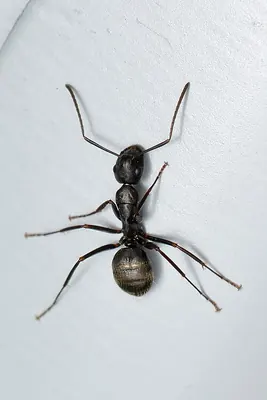
Ants excavate rather than consume wood and may leave coarse fibrous debris.
Compare carpenter ants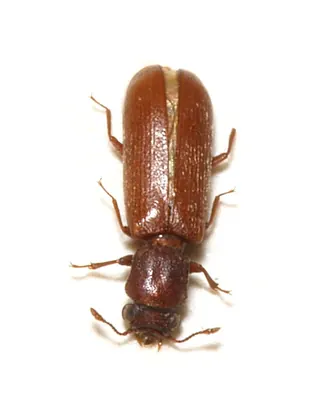
Wood-boring beetles
Round or oval emergence holes and powder differ from termite pellets, but expert debris examination may be needed.
Compare wood boring beetlesDecay or other damage
Soft or hollow wood is a reason for assessment, not a termite identification.
Sources for this section
University of California Statewide IPM Program · University of California IPM · University of California IPM
Inspect the right places
Capture evidence without erasing the route
Photograph tubes, holes or pellets with scale and a wider view of the location. Label a safely collected specimen. Keep a dated record for the inspector.
Request a written inspection
Ask which areas were accessible, what evidence supports the species and current activity, and where uncertainty remains. An inaccessible void should be recorded as a limit, not described as pest-free.
Check conditions and history
Provide previous treatment records, leaks, repairs and recent wood deliveries. Point out drainage, stored timber and wood-to-soil contact without entering hazardous crawlspaces.
Sources for this section
University of California Statewide IPM Program · University of Kentucky Extension
Choose a proportionate response
For pesticides, the local product label determines the allowed pest, site, precautions and timing. Check safety and regional guidance.
Choose treatment after identification
For structural infestations, use a properly licensed provider. Ask why the proposed method fits the termite group and construction, what it reaches, and what it cannot reach.
Compare the full contract
Compare inspected scope, preparation, ongoing inspections, renewal costs, retreatment terms and whether damage repair is covered. A warranty to retreat is not necessarily a warranty to repair timber.
Correct conducive conditions
Repair leaks, maintain drainage and ventilation, and remove stored wood and debris against the building. Preserve required inspection access and comply with local building details.
Separate pest control from repair
Have damaged structural members assessed and repaired by qualified people. Fumigation or baiting does not restore lost strength, and treatment does not prevent every future introduction.
Sources for this section
University of California Statewide IPM Program · US Environmental Protection Agency · University of Kentucky Extension
Avoid these mistakes
- Do not drill, trench, inject or fumigate a building yourself.
- Do not buy a product that merely kills exposed termites and assume it provides structural protection.
- Do not accept a definitive activity or damage estimate from pellets or one photograph.
- Do not move suspect infested wood to another property.
Sources for this section
US Environmental Protection Agency · Florida Department of Agriculture and Consumer Services
Check whether it is working
Use the inspection and servicing dates specified in the written treatment plan. Any personal reminder is editable and is not a scientific clearance interval.
Retain inspection findings, treatment records and follow-up evidence. A lack of swarmers does not establish control. Report new live insects or evidence to the provider and request reassessment.
Get help when…
- Arrange qualified inspection for indoor swarmers, tubes, pellets or suspected damaged timber.
- Seek prompt structural assessment for sagging, instability or visibly compromised load-bearing wood.
- Report a suspected invasive termite through the appropriate local authority.
Prevent a return
- Maintain drainage and repair plumbing or roof leaks.
- Keep vents and inspection zones accessible.
- Inspect incoming wood and avoid unnecessary wood-to-soil contact.
- Retain records when renewing service or buying a property.
Sources for this section
Common questions
Does a swarm in the garden mean the house is infested?
Not automatically. Its location and identification matter. Indoor emergence or building evidence warrants a building inspection.
Is a cheaper spot treatment equivalent to whole-structure treatment?
No. They have different reach and uncertainty. Ask the inspector to explain concealed areas and the consequences of the narrower scope.
Can I compare quotes before deciding?
Yes. Request more than one inspected proposal and compare method, exclusions and warranty. Immediate safety concerns in damaged timber should be assessed separately.
Sources for this section
University of California Statewide IPM Program · University of Kentucky Extension
Sources & scope
References retain their geography and dates. A source-check date is not a claim of independent specialist review.
- Subterranean and Other Termites
University of California Statewide IPM Program. California, United States; termite groups, evidence and building inspection. Species ranges and seasons are local. Checked 2026-10-15.
- Drywood Termites
University of California Statewide IPM Program. California, United States; pellet uncertainty and whole-structure versus local treatment. Checked 2026-10-15.
- Termites: How to Identify and Control Them
US Environmental Protection Agency. United States; structural termiticide use and prevention. Checked 2026-10-15.
- Termite Control: Answers for Homeowners
University of Kentucky Extension. Kentucky, United States; revised March 2026; consumer inspection, contracts and follow-up. Checked 2026-10-15.
- Formosan Subterranean Termite
University of Florida IFAS Extension. United States with Florida emphasis; distribution maps dated 2024; expert identification and tree/structure activity. Checked 2026-10-15.
- Conehead Termite Eradication Program
Florida Department of Agriculture and Consumer Services. Florida, United States; specific reporting programme, not a worldwide distribution statement. Checked 2026-10-15.
- Wood-Boring Beetles in Homes
University of California IPM. Wood damage and debris comparison; historic pesticide recipes excluded. Checked 2026-10-15.
- Carpenter Ants
University of California IPM. Western US carpenter-ant excavation and debris, for comparison with termites. Checked 2026-10-15.
Individual medical or veterinary diagnosis, structural assessment, uncertain species identification and local treatment permissions require the appropriate professional. About our editorial process.
Keep investigating
Carpenter Ants
Carpenter ants excavate wood for shelter; they do not eat it.
Wood Boring Beetles
Exit holes and powder can outlast the insects that made them.
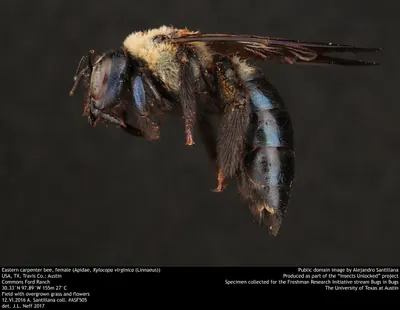
Carpenter Bees
A large bee entering a round timber hole may be a carpenter bee.