
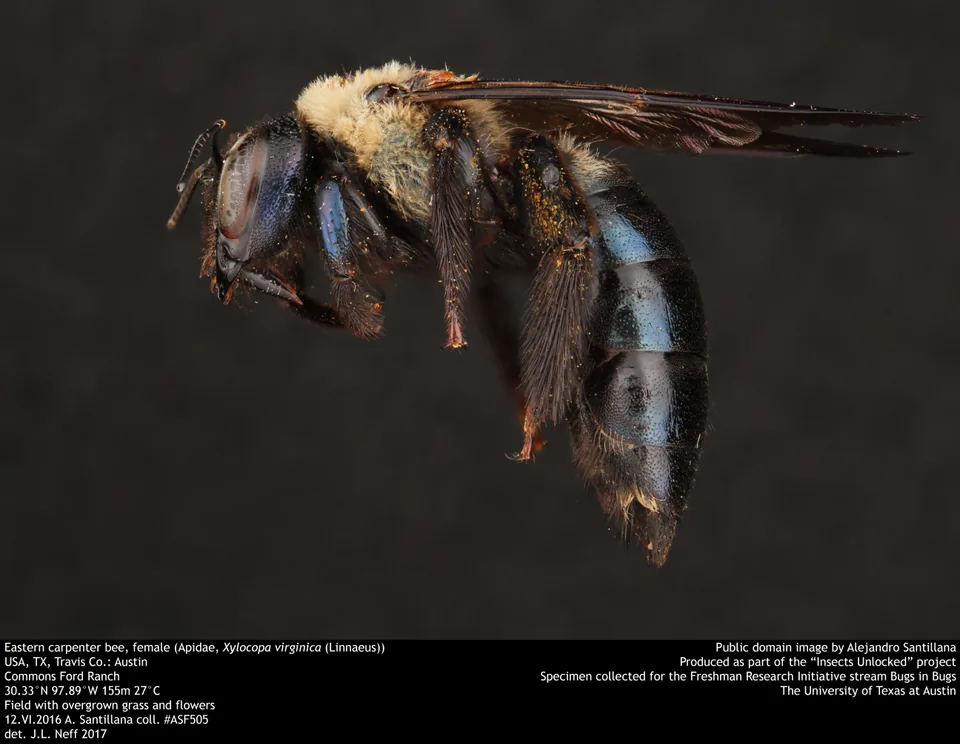
Decide whether intervention is needed
Carpenter bees pollinate plants and often cause limited damage. Where activity is tolerable and timber remains sound, observation and later prevention may be sufficient.
Sources for this section
Recognize the signs
- Bee and entrance
- Large carpenter bees generally have a relatively shiny, sparsely haired abdomen. A round entrance, wood shavings and repeated entry into timber support a nest; a bee merely resting on wood does not.
- Young stages remain inside
- The tunnel contains separate brood cells provisioned with pollen. No adult seen during one brief visit does not prove the tunnel is unoccupied.
Look more closely
Compare the labeled examples and their limits. Images are independently enlarged, not shown at a common scale.
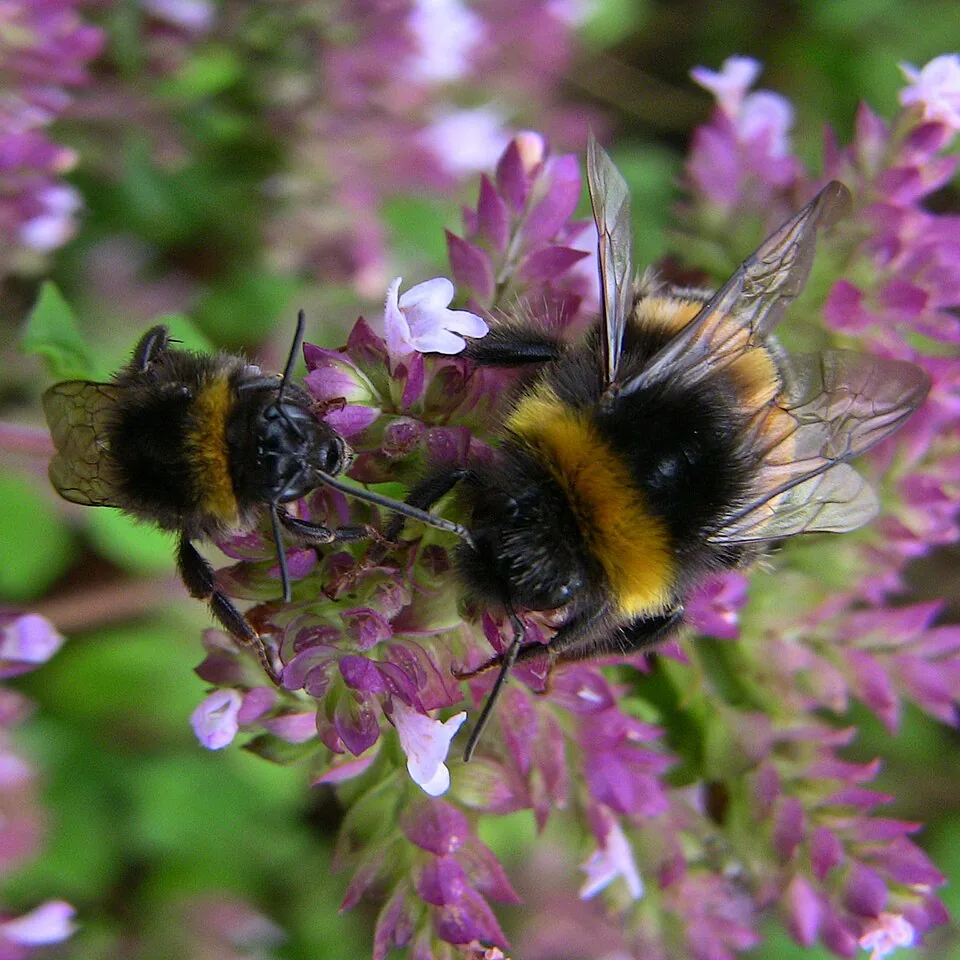
Identification limits & photo credit
Source labels a small female worker at left and larger male at right. This European bumblebee example illustrates a hairy abdomen; it is not a key to North American bumblebees or every bee species.
Two buff-tailed bumblebees on flowers. Photo: linsepatron. CC BY 2.0. Original source · CC BY 2.0 & details
Sources for this section
Differences that change the decision
A similar-looking organism can need a different response. Compare the evidence and what it changes.
Compare every column. On a narrow screen, scroll the table sideways.
| Type | What to check | What changes |
|---|---|---|
| Large carpenter bees | Xylocopa species are robust, with local colour differences; some males are pale or golden. | Use body and nest evidence rather than a universal yellow-and-black pattern. Repeated reuse of a timber can enlarge the gallery system. |
| Small carpenter bees | Small metallic-looking Ceratina often use pithy or cut plant stems rather than structural beams. | Treat this as a plant-stem and beneficial-pollinator question. It is not evidence that the house needs wood-pest treatment. |
Sources for this section
What else could it be?
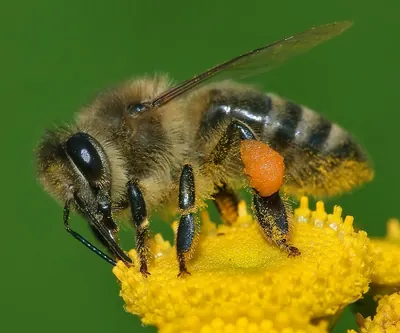
Bumblebees
Usually have a hairier abdomen and use existing cavities rather than excavating a round wood tunnel.
Compare bees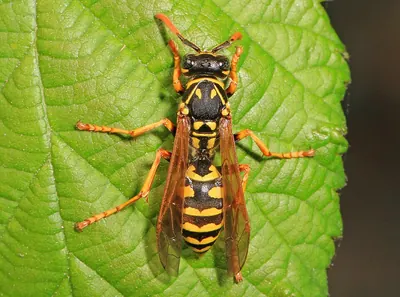
Wasps or other solitary bees
Some use abandoned holes. Identify the current occupant before deciding how to close an entrance.
Compare wasps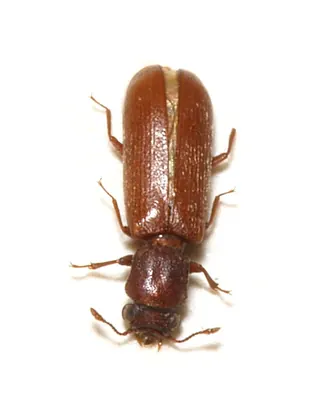
Wood-boring beetles
Small emergence holes and boring powder without bee traffic require another investigation.
Compare wood boring beetlesSources for this section
Inspect the right places
Watch from a distance
Record which hole is used and whether a female carries pollen. Avoid handling bees or approaching closely if anyone is at risk from stings.
Assess the timber history
Check accessible weathered edges, eaves and deck ends for repeated holes or enlarged damage. Elevated and load-bearing areas should be assessed by appropriate professionals.
Sources for this section
Choose a proportionate response
For pesticides, the local product label determines the allowed pest, site, precautions and timing. Check safety and regional guidance.
Decide whether intervention is needed
Carpenter bees pollinate plants and often cause limited damage. Where activity is tolerable and timber remains sound, observation and later prevention may be sufficient.
Repair only after occupancy is resolved
Confirm the tunnel is unoccupied before filling and finishing it. Local season and brood development matter; plugging an active hole is not a reliable removal method.
Protect vulnerable surfaces
Maintain paint or another suitable protective finish and repair cracks. Cover vulnerable rough ends with appropriate building materials where practical.
Escalate repeated structural activity
Ask a qualified professional to assess significant recurring damage and a proportionate method. Any pesticide must be authorised for the exact use, with pollinator and occupant precautions.
Sources for this section
Avoid these mistakes
- Do not plug an active brood tunnel simply because an adult is away.
- Do not spray flowers or every bee around the building.
- Do not treat a hovering male as proof of imminent stinging; males cannot sting, while females can sting if handled or disturbed.
Sources for this section
Check whether it is working
An editable weekly observation during local nesting activity is a practical reminder, not a clearance interval. Recheck repaired areas during the next local activity period.
Record new entrances and reuse separately from old holes. A sealed hole alone does not show that every gallery or affected timber has been assessed.
Get help when…
- Use professional help for high entrances, extensive repeated tunnelling or suspected structural weakness.
- Use a local bee identification or extension service when the occupant or timing is uncertain.
Sources for this section
Prevent a return
- Maintain exposed timber finishes.
- Repair unoccupied old entrances and protect vulnerable end grain.
- Preserve suitable pollinator habitat away from timber that must be protected.
Sources for this section
Common questions
Will they eat the house like termites?
They excavate nest tunnels and provision young with pollen. Repeated use can damage timber, but the biology differs from wood-eating termites.
Should a small bee in a rose stem be treated the same way?
No. Small carpenter bees use stems and have a different management context. Identify the bee and assess the plant before intervening.
Sources for this section
Sources & scope
References retain their geography and dates. A source-check date is not a claim of independent specialist review.
- Carpenter Bees
University of California Statewide IPM Program. California, United States; prevention, unoccupied-hole repair and pollinator role. Old pesticide examples not adopted. Checked 2026-10-15.
- Carpenter Bees
University of Kentucky Extension. Kentucky, United States; revised March 2026; nesting, distinction from bumblebees and repeated damage. Checked 2026-10-15.
- Small Carpenter Bees
NC State Extension. North Carolina, United States; revised February 2026. Page states it has not been peer reviewed; used for Ceratina biology, not chemical recommendations. Checked 2026-10-15.
Individual medical or veterinary diagnosis, structural assessment, uncertain species identification and local treatment permissions require the appropriate professional. About our editorial process.
Keep investigating
Wasps
A foraging wasp, a solitary mud nest and a busy social colony need different responses.
Wood Boring Beetles
Exit holes and powder can outlast the insects that made them.