
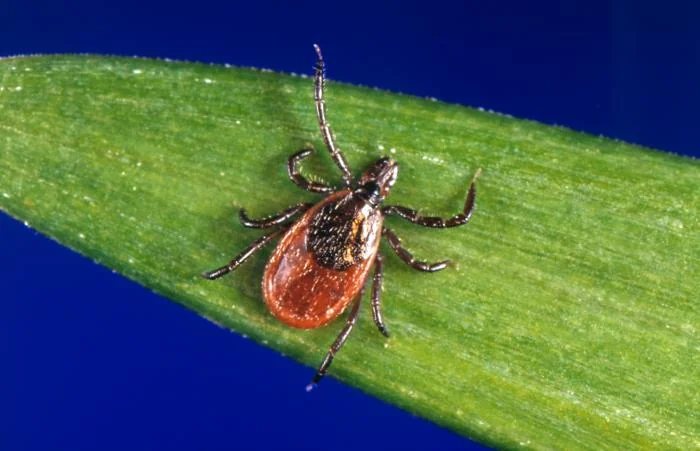
Remove an attached tick
Use fine-tipped tweezers close to the skin and pull upward with steady, even pressure. Avoid crushing the body. Clean the skin and your hands afterwards. If small mouthparts cannot be removed easily, leave them rather than digging into skin.
Recognize the signs
- Count and shape
- Ticks have a compact body and no antennae. Larvae have six legs; nymphs and adults have eight. Feeding changes the size and shape substantially, so an engorged tick may look unlike an unfed reference.
- Stage and behavior
- Eggs hatch into larvae, followed by nymphs and adults. Ticks crawl onto hosts; they do not fly or jump. A tiny nymph can be harder to find than an adult.
Look more closely
Compare the labeled examples and their limits. Images are independently enlarged, not shown at a common scale.
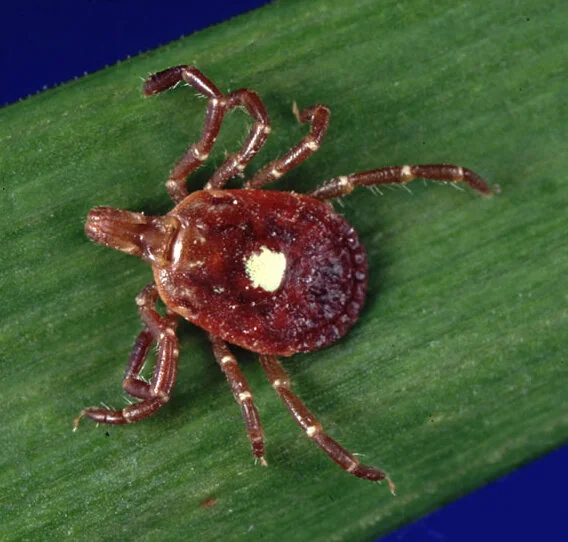
Identification limits & photo credit
One adult female. Males, nymphs, larvae, and engorged ticks differ. No photograph determines whether a tick carries a pathogen or whether transmission occurred.
Adult female lone star tick. Photo: James Gathany; CDC / Michael L. Levin. Public domain. Source: CDC PHIL; original image available free from CDC. Use does not imply CDC, HHS, or U.S. Government endorsement. Original source · Public domain & details
Sources for this section
Differences that change the decision
A similar-looking organism can need a different response. Compare the evidence and what it changes.
Compare every column. On a narrow screen, scroll the table sideways.
| Type | What to check | What changes |
|---|---|---|
| Blacklegged and western blacklegged ticks | Ixodes scapularis and I. pacificus have different US distributions; small nymphs can be easily overlooked. | Give the clinician the exposure location and date. Regional risk is more useful than calling every small tick a deer tick. |
| Lone star tick | Adult females often show one pale dorsal spot; males and immature stages do not have the same pattern. | Do not exclude this group simply because a tiny tick lacks the adult female's spot. |
| American dog and Rocky Mountain wood ticks | Dermacentor adults often have pale ornamentation, with overlapping visual characters. | Species and regional risk need an intact specimen or good photographs, not a decorative pattern alone. |
| Brown dog tick | Often associated with dogs and their resting places; several life stages may occur around a kennel or building. | Repeated indoor findings call for coordinated veterinary and building inspection, rather than yard treatment alone. |
| Gulf Coast tick and Asian longhorned tick | Additional hard ticks occur in parts of the US; local distribution is changing. | Use current local identification services, especially for unfamiliar ticks or heavy animal infestations. |
| Soft ticks | Usually lack the hard dorsal shield; some live around rodent or bird hosts in shelters and rustic cabins. | Report the building and overnight exposure context. A short feeding visit may leave no attached tick to find. |
Sources for this section
What else could it be?
Small beetles
Beetles have six legs, antennae and hard wing covers. Tick larvae also have six legs, so leg count alone is insufficient.
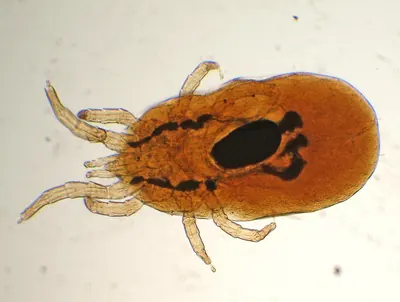
Mites
Many are much smaller and need microscopy. Do not infer a tick from a moving dot or skin mark.
Compare mitesInspect the right places
After outdoor exposure
Check scalp, ears, underarms, waist, groin and behind the knees, using a mirror or another person where needed. Check pets, clothing and equipment too.
Document without delaying removal
Record the body location, discovery time and likely exposure area. Photograph both sides beside a scale after removal if practicable. Keep any saved tick securely contained and away from children.
Sources for this section
Choose a proportionate response
For pesticides, the local product label determines the allowed pest, site, precautions and timing. Check safety and regional guidance.
Remove an attached tick
Use fine-tipped tweezers close to the skin and pull upward with steady, even pressure. Avoid crushing the body. Clean the skin and your hands afterwards. If small mouthparts cannot be removed easily, leave them rather than digging into skin.
Ask about exposure when appropriate
Contact a clinician promptly if you need advice about possible preventive treatment. Eligibility depends on the exposure and timing; antibiotics are not automatically indicated after every tick bite.
Respond to illness
If fever, a new rash or other illness develops after exposure, seek medical advice and mention the date and place. Do not wait for a mailed tick result. Severe symptoms require urgent medical care.
Protect people and pets
Use a locally authorized repellent according to its age and application directions, protective clothing and tick checks. Ask a veterinarian about animal prevention; human repellents and dog products are not interchangeable with cat treatments.
Avoid these mistakes
- Do not burn, paint, smother or twist an attached tick to make it detach.
- Do not rely on a universal safe attachment time: infection risk differs by organism and circumstances.
- Do not use commercial tick-test results to decide whether a person is infected or needs treatment.
Check whether it is working
Check after potential exposure. Following a bite, remain alert for symptoms over the subsequent days and weeks and follow the clinician's specific advice; this is not a fixed diagnostic waiting period.
Removal resolves the attachment, not the question of infection. For a building problem, track confirmed ticks by location and stage while veterinary and pest professionals address the source.
Get help when…
- New fever, rash or illness after a possible exposure needs medical assessment, even if no tick was noticed.
- Multiple indoor ticks or ticks on several pets require a coordinated source investigation.
- A pet becoming unwell after exposure or a product application needs veterinary advice.
Sources for this section
Prevent a return
- Reduce leaf litter and brush along frequently used paths; place play and sitting areas away from dense edge vegetation where feasible.
- Check clothing and gear before bringing them indoors; follow CDC and fabric instructions for washing and drying exposed items.
- Consult current local public-health information. A map of tick presence does not establish the infection status of an individual tick.
Common questions
Should I wait to identify it before removal?
No. Remove it promptly, then use the specimen or photographs for identification.
Does a negative tick test mean I am safe?
No. Tick testing is not a diagnosis of the bitten person, and another unnoticed exposure is possible. Symptoms and the clinical exposure assessment take priority.
Sources for this section
Sources & scope
References retain their geography and dates. A source-check date is not a claim of independent specialist review.
- About Ticks
US CDC. US general tick biology; life stages and questing. Checked 2026-10-15.
- Where Ticks Live
US CDC. US species and distribution information; consult current local data elsewhere. Checked 2026-10-15.
- DPDx: Ticks
US CDC. Diagnostic morphology and host associations; specialist identification rather than a consumer visual certainty. Checked 2026-10-15.
- What to Do After a Tick Bite
US CDC. US clinical referral and removal guidance, updated June 2026; individual treatment decisions belong to a clinician. Checked 2026-10-15.
- Preventing Tick Bites
US CDC. US prevention; label authorizations differ internationally. Checked 2026-10-15.
- Controlling Fleas and Ticks on Your Pet
US EPA. US animal-product precautions; veterinary advice and local labels control use. Checked 2026-10-15.
- Treatment and Intervention for Lyme Disease
US CDC. Updated June 2026; a clinician determines whether post-exposure antibiotics are appropriate. Checked 2026-10-15.
- Know Your Vector: Brown Dog Ticks
Penn State Extension. Pennsylvania and US tick context; transcript read for indoor development and dog-associated source management. Checked 2026-10-15.
Individual medical or veterinary diagnosis, structural assessment, uncertain species identification and local treatment permissions require the appropriate professional. About our editorial process.
Keep investigating
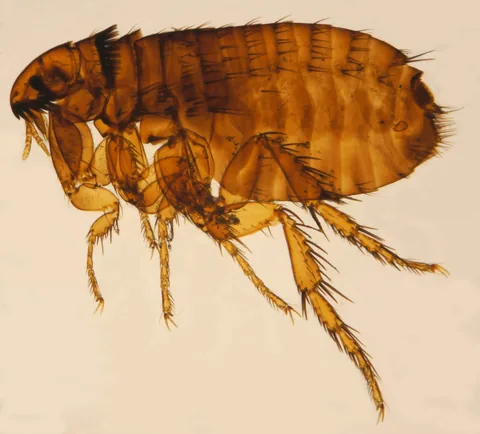
Fleas
Confirm a flea on an animal or in the environment, then coordinate veterinary care with cleaning where animals rest.
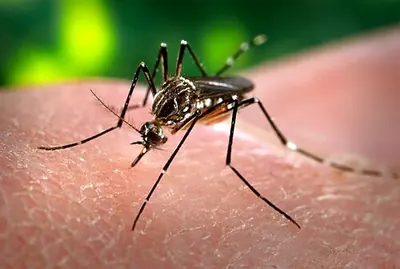
Mosquitoes
Start with water-holding containers and protection from bites.