
Prevent spread now
Keep suspect soil and transplants in place. Clean soil from tools and footwear before working another bed; prevent contaminated runoff or potting material moving between plants.
Sources for this section
Recognize the signs
- Visible limits
- Plant-parasitic nematodes are microscopic. Ordinary worms seen moving in a pot are not a reliable nematode diagnosis.
- Root evidence
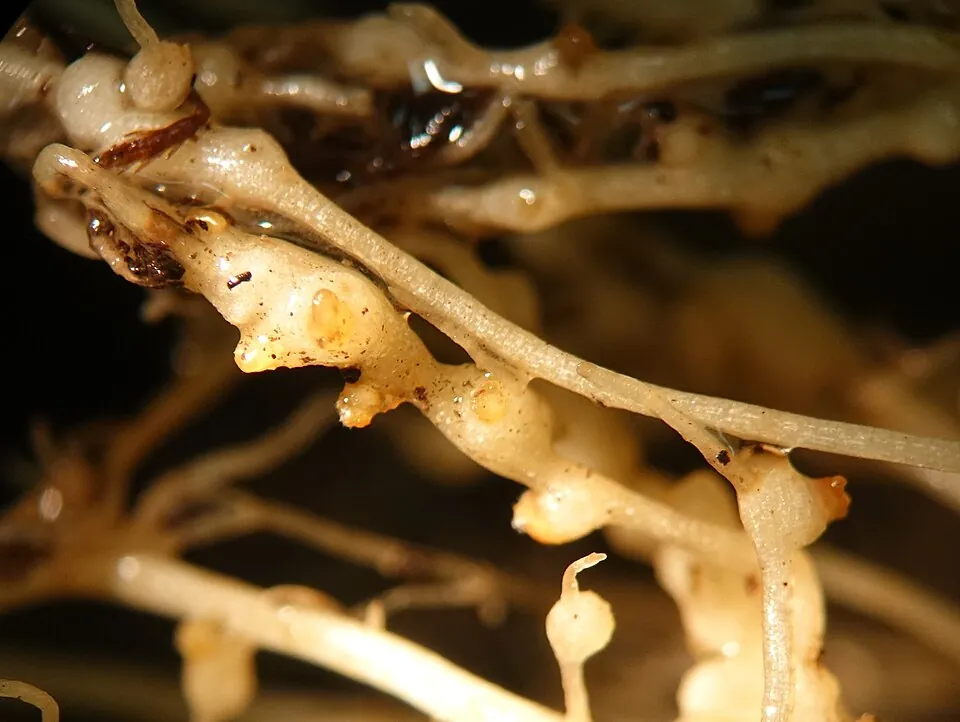
- Root-knot nematodes often cause swellings integral to the root. Other damaging nematodes may leave no distinctive visible gall.
Sources for this section
Differences that change the decision
A similar-looking organism can need a different response. Compare the evidence and what it changes.
Compare every column. On a narrow screen, scroll the table sideways.
| Type | What to check | What changes |
|---|---|---|
| Root-knot nematodes | Galled roots can accompany poor growth, yellowing or wilt despite available water. | Confirm the host and root finding; choose resistance suited to the local nematode rather than assuming all resistant varieties are equivalent. |
| Root lesion, ring and other root-feeding nematodes | Root injury or weak growth may be nonspecific. | Soil and root laboratory samples are needed to distinguish them from disease or cultural injury. |
| Cyst and stem/bulb nematodes | Certain species affect particular crop groups or bulbs rather than producing ordinary root-knot galls. | Host identification and specialist sampling are essential; rotation must use true non-hosts. |
| Beneficial and free-living nematodes | Not all nematodes parasitise plants; some are used against insect pests. | A beneficial nematode product is not a treatment for plant-parasitic nematodes. Do not aim to sterilise all soil life. |
Sources for this section
What else could it be?
Legume root nodules
Nitrogen-fixing nodules differ from root-knot swellings and can be detached; host context matters.
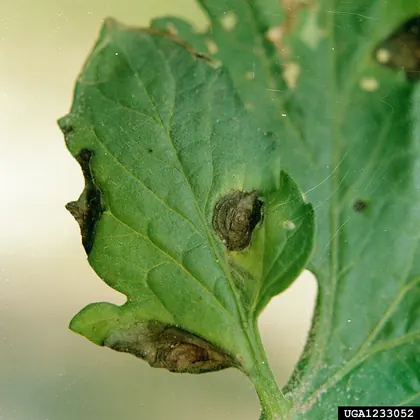
Water stress, root rot or nutrient problems
These can cause the same above-ground symptoms.
Compare plant disease & stressSources for this section
Inspect the right places
Examine a representative plant
Compare roots from a declining plant and a healthy one. Record plant identity, site pattern, irrigation and past crops; photograph galls before discarding material.
Ask the laboratory first
Contact a local plant clinic for sampling depth, season, storage and submission instructions. Sending only a dried dead plant can make diagnosis less useful.
Sources for this section
Choose a proportionate response
For pesticides, the local product label determines the allowed pest, site, precautions and timing. Check safety and regional guidance.
Prevent spread now
Keep suspect soil and transplants in place. Clean soil from tools and footwear before working another bed; prevent contaminated runoff or potting material moving between plants.
Match plants to the identified problem
Use appropriate resistant varieties or rootstocks where available. Crop rotation only helps if the replacement crop and weeds do not host the nematode.
Plan soil measures locally
Fallowing or solarisation may reduce some populations under suitable conditions but are not guaranteed permanent cures. A local adviser should design a plan around species, climate and soil depth.
Sources for this section
Avoid these mistakes
- Do not diagnose from yellow leaves alone.
- Do not assume a few marigolds beside vegetables will cure an infestation; effects depend on marigold and nematode species and the planting programme.
- Do not buy a nematicide or soil treatment without confirming the pest and lawful use.
Sources for this section
Check whether it is working
Suggested practice: track growth through the crop cycle and inspect roots at removal. Repeat laboratory sampling at the diagnostic service's recommended season, not an invented universal interval.
Improved growth and yield on suitable plants with reduced root injury or relevant laboratory counts; absence of visible galls does not exclude every nematode.
Get help when…
- Unexplained recurring root decline or root galls: local plant diagnostic laboratory.
- Suspected regulated nematode on purchased stock: plant-health authority before moving material.
Sources for this section
UC Statewide IPM Program · Virginia Cooperative Extension · Canadian Food Inspection Agency
Prevent a return
- Use healthy nursery plants and clean growing material.
- Keep equipment clean and choose resistance based on the diagnosed local species.
Sources for this section
Common questions
Can I see the nematode in a root gall?
Generally not without microscopy. The swelling is plant tissue responding to feeding; identification may need a laboratory.
Will rotating to any different vegetable solve it?
No. Many root-knot nematodes have broad host ranges, including weeds. Rotation needs a confirmed non-host.
Sources for this section
Sources & scope
References retain their geography and dates. A source-check date is not a claim of independent specialist review.
- Nematodes
UC Statewide IPM Program. California, United States; biology may transfer, management timing and permitted products require local verification; source date 2010-07; source check, not expert review Checked 2026-10-15.
- Biological Control and Natural Enemies of Invertebrates
UC Statewide IPM Program. California, United States; biology may transfer, management timing and permitted products require local verification; source check, not expert review Checked 2026-10-15.
- Diagnosing Plant Problems
Virginia Cooperative Extension. Virginia, United States; general diagnostic method; source date 2023-11 review; source check, not expert review Checked 2026-10-15.
- Plant pest surveillance
Canadian Food Inspection Agency. Canada; current regulated areas and reporting requirements need local verification; source check, not expert review Checked 2026-10-15.
Individual medical or veterinary diagnosis, structural assessment, uncertain species identification and local treatment permissions require the appropriate professional. About our editorial process.
Keep investigating
Plant disease & stress
Start with the plant, the pattern and its growing conditions.
Weeds
Identify the plant and whether it returns from seed, roots or tubers.
Beneficial Insects
Before removing an insect, check what it is eating and which life stage you are seeing.