
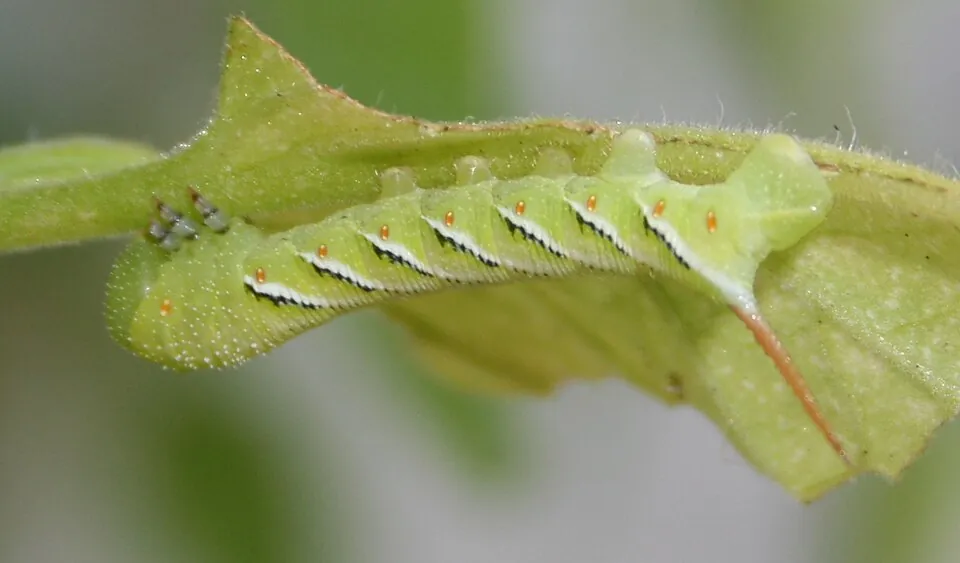
Remove confirmed feeding larvae
Hand-remove reachable pests, protecting yourself from unknown hairs or spines. Leave unknown or parasitoid-bearing larvae for identification rather than handling them indiscriminately.
Recognize the signs
- Chewing evidence
- Fresh holes or missing leaf edges plus frass and a larva support a caterpillar diagnosis. Damage alone cannot separate slugs or beetles.
- Caterpillar or sawfly
- Most true caterpillars have two to five pairs of abdominal prolegs; many sawfly larvae have six or more. Some slug-like sawflies are harder to judge.
Look more closely
Compare the labeled examples and their limits. Images are independently enlarged, not shown at a common scale.
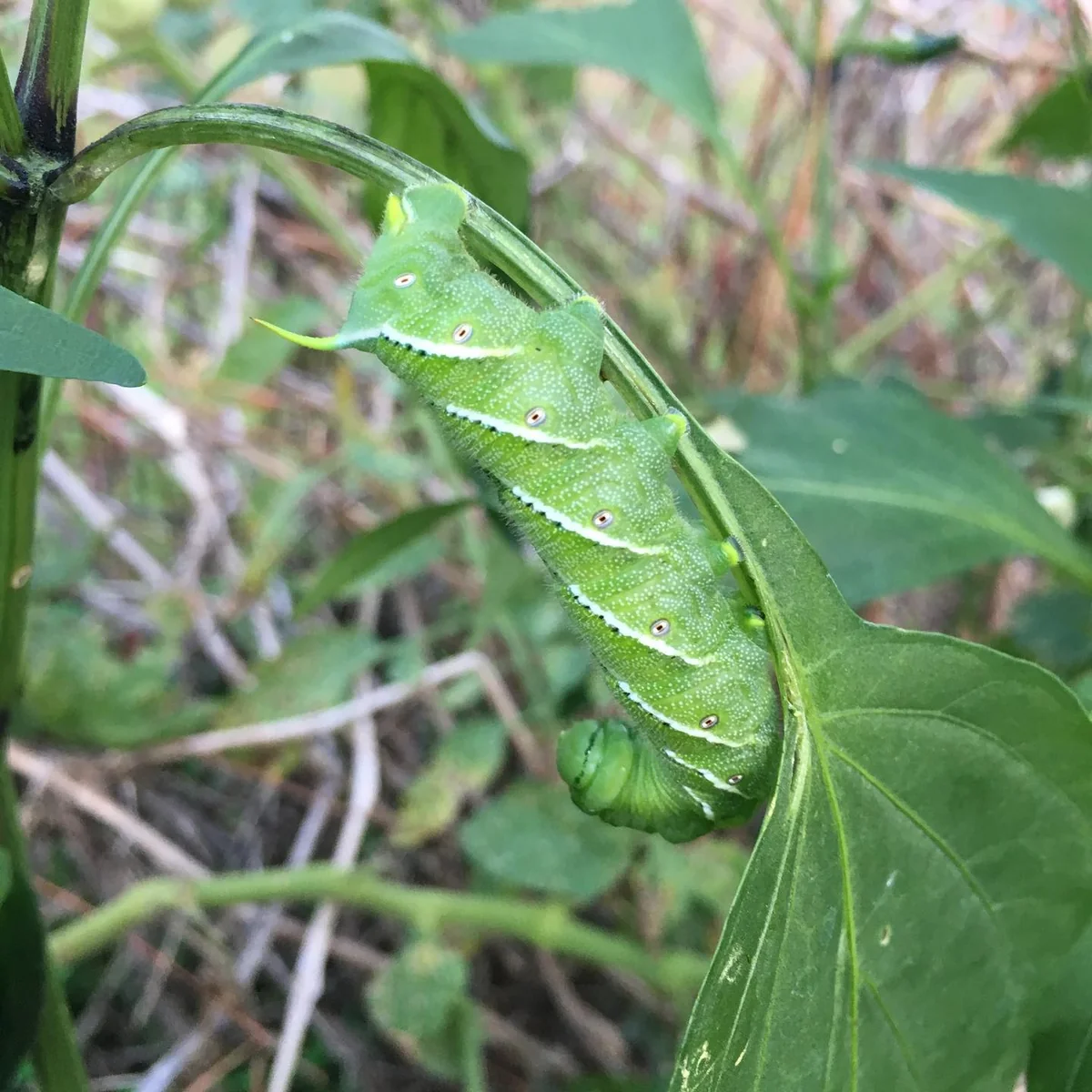
Identification limits & photo credit
A tobacco hornworm example. The rear horn is not clearly shown in this view; do not relabel it as a tomato hornworm or use it alone to separate the two species.
Tobacco hornworm on a jalapeño pepper plant. Photo: Macgeek13. CC BY-SA 4.0. Original source · CC BY-SA 4.0 & details
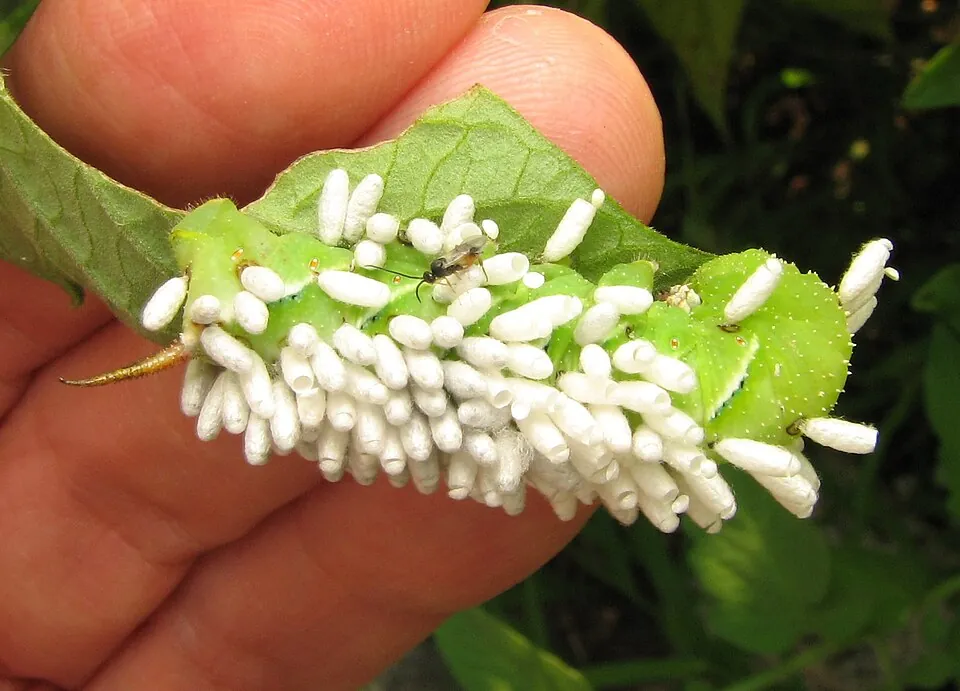
White parasitoid cocoons change the response: retain this larva for parasitoid emergence rather than removing every caterpillar.
Identification limits & photo credit
White structures are wasp cocoons, not caterpillar eggs. The source identifies Cotesia congregata on Manduca sexta. This example is not a plate for every parasitoid; do not handle an unknown caterpillar to reproduce the view.
Parasitoid-wasp cocoons on a tobacco hornworm. Photo: Beatriz Moisset. CC BY-SA 4.0. Original source · CC BY-SA 4.0 & details
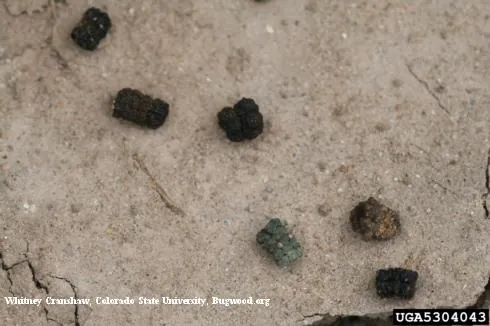
Identification limits & photo credit
The source identifies these dry pellets as frass of tomato hornworm, Manduca quinquemaculata, photographed in Colorado. They are not labelled as tobacco-hornworm frass. Droppings prompt a search for a caterpillar and fresh feeding injury; pellets alone cannot confirm the species, show that a caterpillar is still present or establish a treatment threshold.
Dry tomato-hornworm frass beneath an infested plant. Photo: Whitney Cranshaw, Colorado State University, Bugwood.org. CC BY 3.0 US. Original source · CC BY 3.0 US & details
Sources for this section
University of Minnesota Extension · University of Minnesota Extension
Differences that change the decision
A similar-looking organism can need a different response. Compare the evidence and what it changes.
Compare every column. On a narrow screen, scroll the table sideways.
| Type | What to check | What changes |
|---|---|---|
| Tomato and tobacco hornworms | Large green larvae with a rear horn, substantial frass and rapid loss of tomato-family foliage. Tomato hornworms commonly show white V marks. | Search leaf undersides and stems near fresh damage; hand removal is usually practical. Do not assign species from a hole alone. |
| Cabbageworm, cabbage looper and diamondback moth | Cabbage-family feeding; velvety green cabbageworms, looping movement of loopers, and small wriggling diamondback larvae offer clues. | Look on undersides and inside forming heads. Use early exclusion and remove identified larvae. |
| Cutworms and armyworms | Some cutworms sever seedlings at soil level and hide by day; others and armyworms chew foliage. | Inspect at dusk and around the damaged plant's base. Protect new transplants and locate active larvae. |
| Leafrollers and fruitworms | Leafrollers shelter in silk-tied leaves. Tomato fruitworms can tunnel inside fruit, leaving a messy cavity. | Open a sample shelter or fruit for diagnosis; remove infested material. A leaf treatment may not reach a protected larva. |
| Squash vine borer | A wilting squash or pumpkin with a basal entry hole and moist green-to-orange sawdust-like frass suggests a stem-feeding larva. | Inspect the crown and lower stem. Wilting alone also fits squash bugs, bacterial wilt or root/water problems; internal larvae are protected from most foliar sprays. |
| Roseslugs and other sawflies | Sawfly larvae may have six or more abdominal proleg pairs; slug-like forms have less obvious legs. On roses, windowpane feeding can leave translucent leaf tissue rather than a hornworm-like missing edge. | Confirm larva and host. Healthy mature deciduous plants often tolerate a season of feeding; needle loss on conifers or repeated defoliation of young plants merits earlier assessment. Btk does not control sawflies. |
What else could it be?
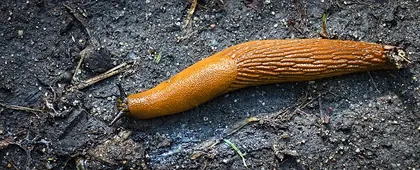
Slugs and snails
Night feeding, slime and the animal itself support this alternative.
Compare slugs & snails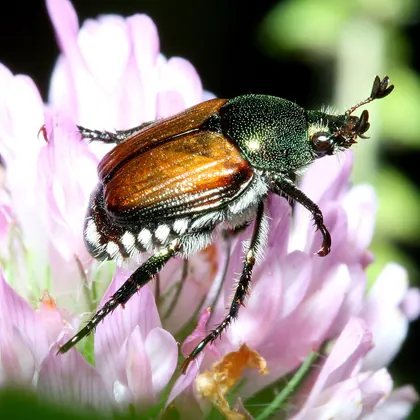
Beetle adults or larvae
Some cause shot holes or skeletonising; inspect for the insect.
Compare garden beetles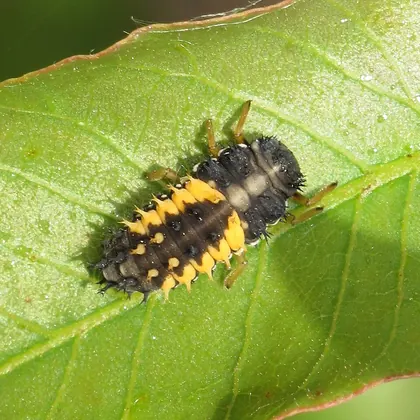
Beneficial parasitoid cocoons
White rice-like cocoons on a hornworm can be developing parasitic wasps.
Compare beneficial insects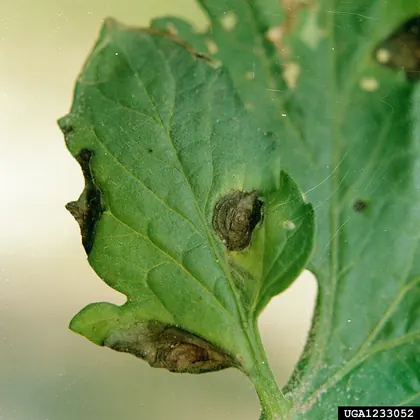
Cucurbit wilt from other causes
Squash bugs, cucumber-beetle-associated bacterial wilt, root disease and water stress can all cause wilt; inspect for their evidence rather than treating the symptom.
Compare plant disease & stressSources for this section
University of California Statewide IPM Program · University of Minnesota Extension
Inspect the right places
Follow the damage
Check above fresh frass and along stems, leaf undersides and growing tips. For a cut stem, search adjacent soil and sheltered debris.
Check beneficial activity
Photograph any cocoon-covered hornworm and leave it when feasible so parasitoids can emerge. Do not mistake cocoons for more caterpillar eggs.
Inspect wilting cucurbits at the base
On squash or pumpkin, examine the crown and lower stem for an opening, fresh moist frass and soft damaged tissue. Morning wilt deserves attention; a hot-afternoon droop alone does not identify vine borer.
Match sawfly loss to host and active stage
Look at affected and healthy branches and whether larvae are still feeding. Some conifers cannot replace consumed needles as a deciduous plant can replace leaves. Remove small accessible confirmed colonies physically when practical; assessment of advancing conifer loss should not wait for a generic cosmetic-damage threshold.
Choose a proportionate response
For pesticides, the local product label determines the allowed pest, site, precautions and timing. Check safety and regional guidance.
Remove confirmed feeding larvae
Hand-remove reachable pests, protecting yourself from unknown hairs or spines. Leave unknown or parasitoid-bearing larvae for identification rather than handling them indiscriminately.
Protect the next vulnerable stage
Use appropriate row cover before moth access, checking that pests are not underneath and that pollination and heat needs are met. A transplant collar can deter stem-cutting cutworms.
Choose selective treatment only when justified
A locally registered Btk product must be eaten by susceptible young caterpillars; it is not a universal worm treatment. Follow the crop label and protect non-target butterfly larvae.
Manage a confirmed squash vine borer
Remove and contain a badly infested vine before larvae leave it, using local disposal advice. Prompt careful removal of a larva from a slit stem sometimes saves a plant but is not assured; ask local horticultural advice if uncertain. For the next planting, rotate away from the affected area and exclude egg-laying moths while allowing pollination. Product decisions must target the locally observed vulnerable stage, before larvae are sheltered inside stems.
Avoid these mistakes
- Do not spray every caterpillar on a mature tree for limited cosmetic loss.
- Do not use a caterpillar-specific product for sawflies.
- Do not discard the parasitoid cocoons on an otherwise manageable hornworm.
- Do not inject improvised pesticide mixtures into squash vines or assume Btk applied to leaves will reach a larva inside a stem.
Sources for this section
University of Minnesota Extension · University of Minnesota Extension
Check whether it is working
UMN advises checking tomatoes for hornworms at least twice weekly in summer and cole crops at least weekly. Use local season cues elsewhere; inspect cutworm damage when fresh and search at dusk.
No new missing foliage, severed seedlings or occupied fruit/silk shelters; old holes remain. Compare new damage, not repaired leaves.
Get help when…
- Fast defoliation of young or evergreen plants, tree decline or uncertain hairy larvae: local plant professional.
- Unusual caterpillars on imported stock or a suspected invasive species: plant-health authority.
Sources for this section
University of Minnesota Extension · University of Minnesota Extension · University of Minnesota Extension
Prevent a return
- Inspect seedlings and both sides of leaves.
- Remove confirmed infested crop residues and conserve predators and parasitoids.
Sources for this section
University of Minnesota Extension · UC Statewide IPM Program · UC Statewide IPM Program
Common questions
Are holes in my tomato leaves always hornworms?
No. Hornworms need supporting evidence such as a large horned larva and fresh frass. Slugs, beetles and other caterpillars can also chew leaves.
Why leave a hornworm with white cocoons?
The cocoons can hold parasitoid wasps that attack hornworms. Leaving them supports natural control; verify the appearance before deciding.
Sources for this section
Sources & scope
References retain their geography and dates. A source-check date is not a claim of independent specialist review.
- Tomato hornworms
University of Minnesota Extension. Minnesota, United States; season dates and field thresholds are not universal; source date reviewed 2020; source check, not expert review Checked 2026-10-15.
- Caterpillars on cole crops
University of Minnesota Extension. Minnesota, United States; cole-crop context; source check, not expert review Checked 2026-10-15.
- Sawflies
University of Minnesota Extension. Minnesota, United States; season dates and field thresholds are not universal; source check, not expert review Checked 2026-10-15.
- Cutworms
University of Minnesota Extension. Minnesota, United States; home-garden biology and physical control, not farm thresholds or universal seasonal timing; source check, not expert review Checked 2026-10-15.
- Tomato Fruitworm
UC Statewide IPM Program. California agriculture; used for identification and damage, not commercial pesticide prescriptions; source check, not expert review Checked 2026-10-15.
- Leafrollers on Cole Crops
UC Statewide IPM Program. California coastal cole crops; used for shelter, feeding and natural-enemy biology; source check, not expert review Checked 2026-10-15.
- Snails and Slugs
University of California Statewide IPM Program. California, United States; host, climate and local species matter; source date 2018-03; source check, not expert review Checked 2026-10-15.
- Biological Control and Natural Enemies of Invertebrates
UC Statewide IPM Program. California, United States; biology may transfer, management timing and permitted products require local verification; source check, not expert review Checked 2026-10-15.
- Squash vine borers
University of Minnesota Extension. Minnesota, United States; June/July activity dates and generation count are regional, not universal; no injection or pesticide-rate advice reproduced; source date reviewed 2026; source check, not expert review Checked 2026-10-15.
Individual medical or veterinary diagnosis, structural assessment, uncertain species identification and local treatment permissions require the appropriate professional. About our editorial process.
Keep investigating
Slugs & snails
Inspect after dark for the animal or fresh slime near chewed plants.
Garden Beetles
Identify the beetle and its host before removing it.
Beneficial Insects
Before removing an insect, check what it is eating and which life stage you are seeing.